


PM urges Chinese businesses to boost high-quality, advanced-tech investments

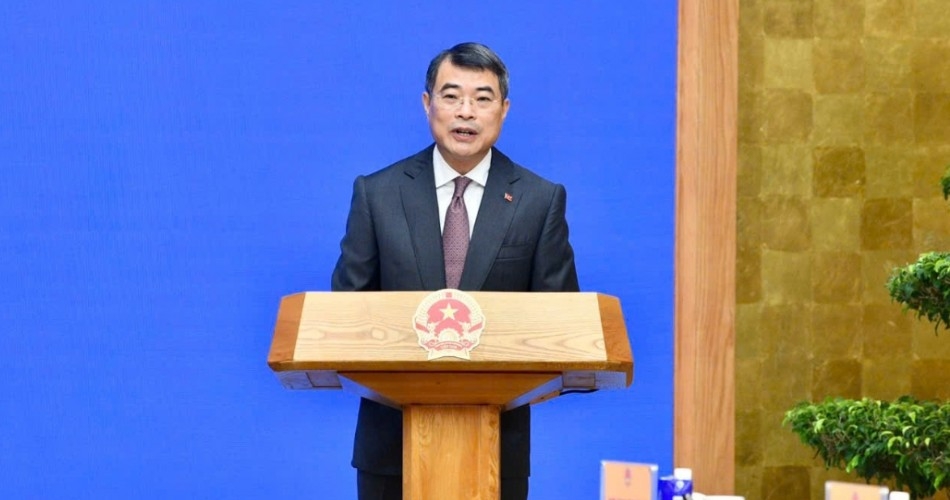
VOV.VN - Prime Minister Le Minh Hung called on Chinese enterprises to step up high-quality investments featuring advanced technologies and greater spillover effects in Vietnam, during a meeting with Chinese business representatives on the morning of August 26 in Hanoi.
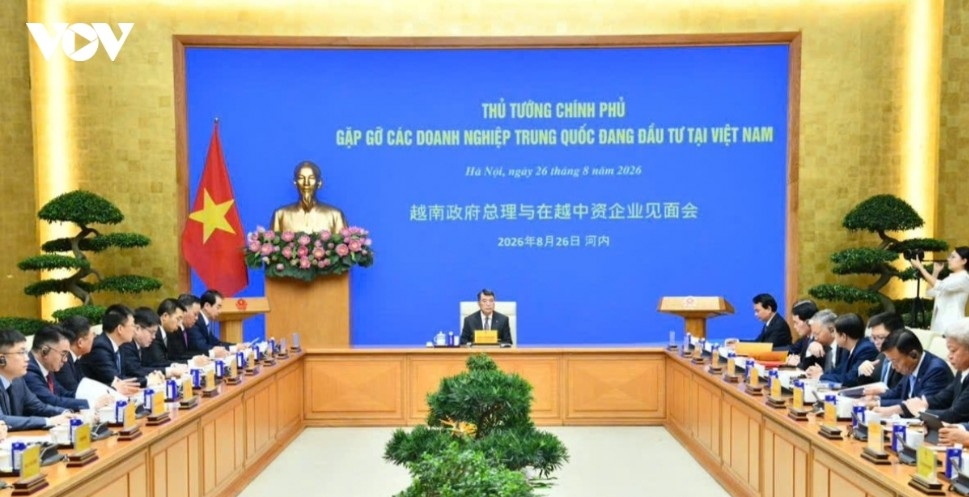
The meeting brought together leaders of Vietnamese ministries, central agencies, and local authorities, alongside Chinese Ambassador to Vietnam He Wei and representatives of leading Chinese enterprises across six key sectors: processing and manufacturing; energy; infrastructure; high-tech agriculture; telecommunications and digital transformation; and finance and banking.
In a candid, constructive, and pragmatic spirit, business representatives exchanged views on their investment and production activities, outlined specific difficulties and root causes, and raised proposals for resolution by the Vietnamese Government, ministries, and localities.
Expressing sincere thanks for the attention of the Party, State, and Government of Vietnam, Chinese enterprises highly praised Vietnam’s continuously improving investment environment, particularly the positive outcomes of organizational restructuring, clear accountability, and streamlined procedures.
Reaffirming Vietnam as an increasingly strategic market, Chinese businesses shared plans to expand operations and discussed new cooperative opportunities. Representatives of Vietnamese ministries, agencies, and localities responded to and clarified issues of mutual concern.
During the session, Ambassador He Wei extended his best wishes on Vietnam’s National Day (September 2), expressing confidence that Vietnam will achieve even greater developments in the new era. Noting that the participating businesses represent leading Chinese corporations, the diplomat affirmed that more Chinese enterprises will certainly invest and expand in Vietnam in the coming time.
According to reports at the meeting, bilateral trade reached approximately US$184.3 billion in the first seven months of 2026, up 35.1% year-on-year. Total registered capital from Chinese investors in Vietnam approached US$3.7 billion, with China ranking first in the number of new investment projects at around 850.
Cumulatively as of late July 2026, Chinese investors held over 7,000 valid projects in Vietnam with total registered capital of nearly US$37 billion, increasingly concentrated in processing, manufacturing, infrastructure, energy, electronics, and technology.
Addressing the event, PM Le Minh Hung acknowledged the determination of Chinese enterprises to expand long-term operations in Vietnam. He stated that Vietnam is entering a new development stage, implementing the Resolution of the 14th National Party Congress and strategic resolutions of the Central Committee and the Politburo, focusing on transforming its growth model toward rapid, sustainable development, aiming for double-digit growth built upon a bedrock of macroeconomic stability, with science, technology, innovation, digital transformation, green transition, and labor productivity as core pillars.
Resolution No. 10 dated June 8, 2026, of the Politburo on foreign-invested economic development sets out a new approach, establishing foreign direct investment as an important component of the national economy.
The Vietnamese Government leader noted that Vietnam-China relations have developed very positively, stably, and deeply. Vietnam consistently considers developing relations with China a consistent policy, an objective requirement, a strategic choice, and a top priority in its overall foreign policy of independence, self-reliance, self-resilience, multilateralization, and diversification.
Both sides are actively implementing the high-level shared perception reached between the top leaders of the two Parties and States, advancing the Comprehensive Strategic Cooperative Partnership and building a Vietnam–China Community with a Shared Future of Strategic Significance at a higher level in the new era.
Economic, trade, and investment cooperation remains a vital pillar and bright spot in bilateral ties. China is Vietnam’s largest trading partner, while Vietnam is China’s largest trading partner within ASEAN.
Highlighting Vietnam's socio-economic performance, the Prime Minister emphasized that given the vast potential, strengths, and complementarity of the two economies, room for cooperation remains immense. In this new phase, it is no longer just a matter of investing "more," but "better," with "higher quality," and "greater substantive efficiency."
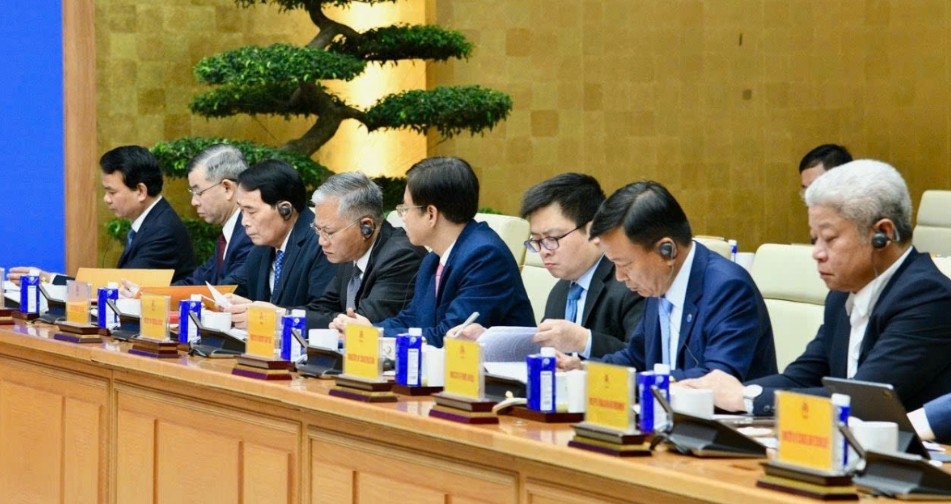
Accordingly, PM Hung called on Chinese enterprises to view Vietnam as a long-term investment destination, expand high-quality investments featuring advanced technologies and greater spillover effects, and coordinate closely with Vietnamese firms to better leverage economic synergies.
He asked businesses to adhere closely to the key cooperation orientations agreed upon by top leaders, pioneering in translating high-level agreements into concrete projects. Priorities include strategic infrastructure connectivity, particularly cross-border railway links, urban railways, logistics, and smart border gates, along with clean energy, modern manufacturing, digital economy, AI, semiconductors, 5G, big data, and emerging industries.
The Government chief requested Chinese firms to shift strongly toward high-value, tech-driven investments with high spillover impacts; step up R&D and innovation; foster linkages enabling Vietnamese firms to join supply chains and raise localization rates; facilitate technology transfer and human resource training; adhere to green and sustainable standards; and fulfill corporate social responsibilities.
The Head of Government emphasized that every project must deliver mutual benefits, contributing to Vietnam's production capacity, technology, employment, tax revenue, and domestic business growth. Major projects must bring advanced technology, managerial expertise, and internationally competitive solutions, creating quality landmarks in bilateral cooperation.
PM Le Minh Hung agreed in principle with and issued specific directives to resolve 44 recommendations across six sectors submitted by Chinese enterprises. He noted that Vietnam is accelerating institutional improvements, streamlining administrative procedures, especially via the National Public Service Portal to eliminate redundant data requests, ensuring transparent, predictable regulations that minimize compliance time and costs.
Furthermore, he instructed the Minister of Finance to establish a mechanism to rapidly receive and address feedback from enterprises, including Chinese investors. Ministries, sectors, and localities must proactively provide guidance and decisively resolve all legitimate concerns.
Emphasizing a spirit of mutual development and value creation, the cabinet leader called for a shift from scale expansion to quality enhancement; from processing and assembly to high technology and innovation; and from standalone projects to integrated, long-term supply chains and ecosystems.
Reaffirming the foundation of traditional friendship and political trust, PM Le Minh Hung stressed that while the two Governments hold the responsibility to operationalize high-level directives, the business community acts as the direct force turning cooperation goals into new practical values for both nations.
The Government of Vietnam, he assured, will continue to listen, accompany, and safeguard the legitimate rights and interests of investors, while offering favorable conditions for enterprises to achieve sustainable success in Vietnam.

Chinese new energy, manufacturing enterprises turn attention to Vietnamese market
VOV.VN - Authorities and business leaders in Dezhou, a city in China's Shandong province, see Vietnam as a high-potential market for economic cooperation, citing the country's improving investment climate and surging demand for infrastructure, green transition, and industrial growth.
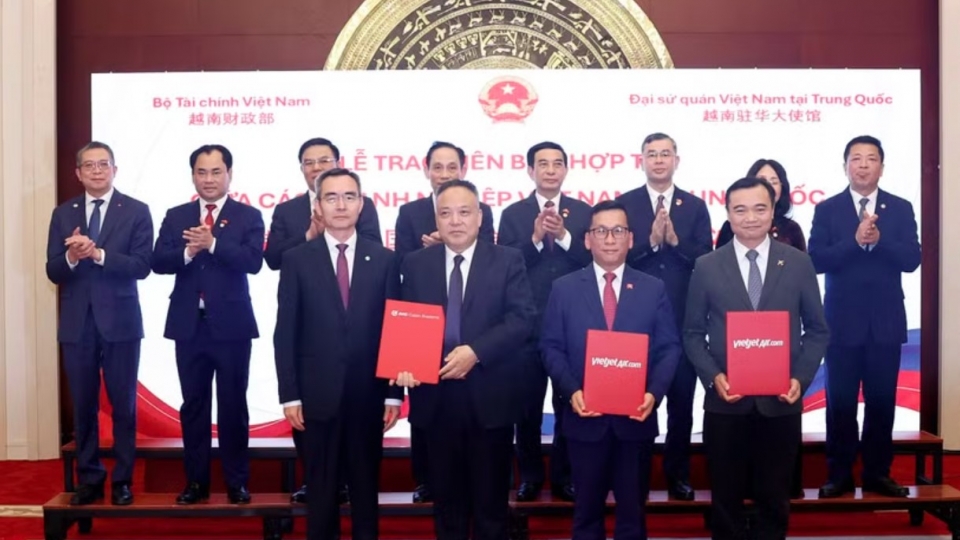
Vietjet exchanges cooperation agreements with Chinese enterprises
Vietjet and SPDB Financial Leasing (SPDBFL), a subsidiary of Shanghai Pudong Development Bank, have exchanged an agreement for the finance lease of 10 COMAC C909 aircraft, expanding financial and aviation cooperation between Vietnam and China.

