Government chief stresses rare earth industry development to strengthen strategic autonomy

VOV.VN - Prime Minister Pham Minh Chinh on January 17 chaired a meeting of the Government Standing Committee to review several key issues, with the participation of Deputy Prime Ministers and leaders of ministries and government agencies.
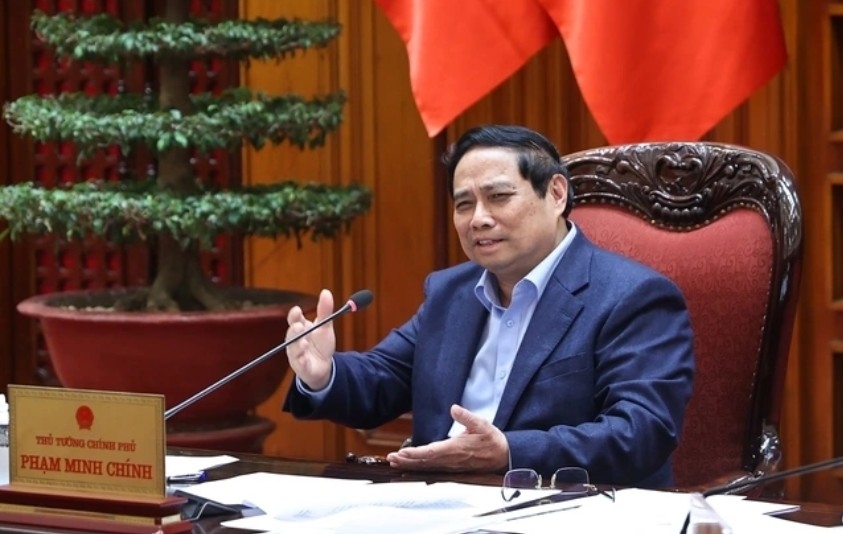
During the meeting, the Government Standing Committee discussed and gave opinions on a number of matters, including the development of a national strategy on rare earths, a draft government resolution on mechanisms to address difficulties facing transitional build–transfer (BT) projects, and a draft decree detailing the handling of bottlenecks in transport BT projects, along with other issues.
On the formulation of the national rare earth strategy, the Government leader stressed the need to strengthen state management in the sector and to develop a rare earth industry that contributes to strategic autonomy.
He highlighted key tasks and solutions, including strengthening institutional frameworks, mechanisms and policies, with priority given to deep processing; mobilising financial investment from the state, public–private partnerships and private investors; developing infrastructure; transferring and mastering appropriate advanced technologies; promoting public–private cooperation; and applying smart governance based on digital transformation.
PM Chinh instructed the Ministry of Agriculture and Environment, together with relevant agencies, to coordinate closely, incorporate feedback from the meeting and finalise the drafts, reports and proposals for submission to competent authorities for consideration.
Regarding mechanisms to resolve difficulties facing transitional BT projects, he directed the Ministry of Finance and related agencies to absorb opinions and complete the draft government resolution for issuance under expedited procedures.
He underlined the need to comply with legal regulations and proper authority, while balancing interests and sharing risks among the state, businesses and the public.
Projects that have already been subject to inspection conclusions will be handled accordingly, while those without inspection findings will be assigned to provincial-level administrations for inspection and resolution under the principle of decentralisation and local responsibility.
Ministries and agencies were asked to carry out tasks within their authority and report to the Government and the Prime Minister on any matters beyond their mandate.

Lawmakers call for strict management of rare earths nationwide
VOV.VN - Lawmakers on December 1 emphasised the urgent need for a strict management framework for rare earths, a strategic national resource, to ensure economic efficiency while safeguarding national defence and controlling environmental risks.

Vietnam not to export rare earth elements, says Deputy PM
VOV.VN - Vietnam will not export raw rare earth elements, affirmed Deputy Prime Minister Tran Hong Ha at the question-and-answer session of the National Assembly in Hanoi on June 4.