
France supports Vietnam’s growing role in international arena: French Ambassador

French Ambassador to Vietnam Olivier Brochet has underlined his country’s support for the Southeast Asian nation’s greater role in the international arena during in an interview granted to the press.
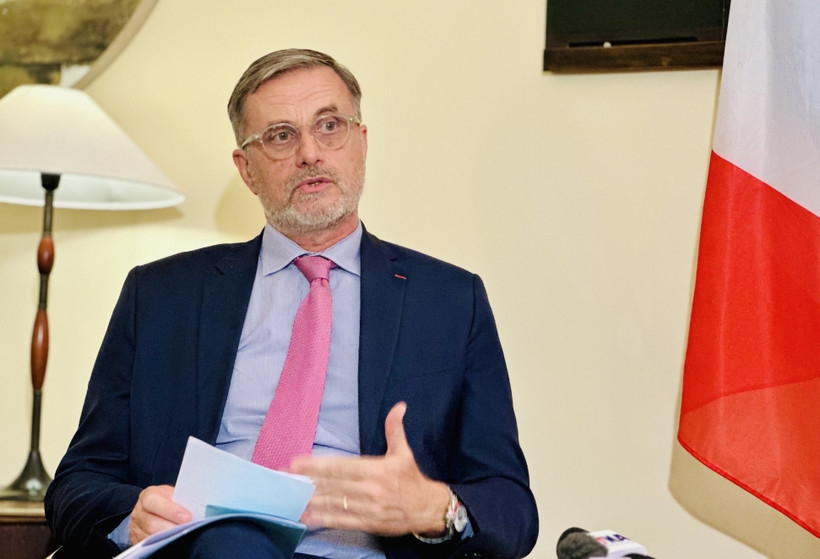
Mentioning the significance of the 14th National Congress of the Communist Party of Vietnam, he said the 14th Congress came at a pivotal moment for Vietnam, both domestically and internationally. It marked the culmination of a highly structured political process during which Vietnam has accelerated its economic and administrative reforms.
Several key pieces of legislation were adopted by the National Assembly in 2025, particularly those related to investment, economic governance, and public policy. These reforms are being closely monitored by international investors, including French and European ones.
Amid growing fragmentation, and significant and persistent uncertainties about the future around the world, he noted, France and Vietnam share a common commitment to essential principles: trust and respect for partners, the defence of sovereignty, and the preservation of multilateralism in order to find collective solutions to the world's vital challenges. These principles provide predictability and stability, and are indispensable for long-term development.
As a comprehensive strategic partner, France intends to back Vietnam with a very concrete approach as it has done for the past 40 years: support for reforms, financing of structure projects, and long-term partnerships in key sectors of the Vietnamese economy, he said.
The ambassador went on to say that Vietnam has set clear objectives for 2030 and 2045 – economic growth in tandem with social development, green transition, and the digital economy. This trajectory is shaping its regional and international role, which it intends to fully embrace to secure greater stability.
France supports Vietnam's international role, primarily through concrete cooperation initiatives on global issues, he said, elaborating that on climate, for example, France supports Vietnam's commitments within the framework of the Just Energy Transition Partnership (JETP), with a contribution of EUR500 million (US$591.4 million) via the French Development Agency (AFD), which has already translated into concrete projects on the electricity grid and energy infrastructure.
In the fields of transport and infrastructure, France is keen to collaborate with Vietnam on large-scale projects, whether in rail, urban connectivity, or civil aviation. These structure projects are essential for development and contribute directly to Vietnam's regional integration and attractiveness.
Finally, Brochet added, Vietnam is increasingly asserting itself as a committed actor in the pursuit of international peace and stability.
He said that together with the EU, France has assisted Vietnam’s Department of Peacekeeping Operations. It also welcomes Vietnam’s hosting of the signing ceremony for the United Nations Convention against Cybercrime, which demonstrates the Southeast Asian country's capacity to play a normative role on the international stage. Furthermore, France is working with Vietnam when the latter holds the chairmanship of the Review Conference of the Parties to the Treaty on the Non-Proliferation of Nuclear Weapons.
This commitment is also reflected in Vietnam's participation in major multilateral coalitions on global public goods. For example, Vietnam fully supports the Paris Pact for People and Planet, and has made commitment to ocean governance by ratifying the High Seas Treaty, scheduled to enter into force on January 17, 2026, according to him.
Commenting on Vietnam’s achievements over 40 years of Doi moi (Renewal), the ambassador said that four decades since the launch of Doi moi in 1986, Vietnam has profoundly transformed its economy, drastically reduced poverty, modernised infrastructure, and diversified its international partnerships.
France has supported Vietnam's development since the latter’s reunification, investing early in cultural, scientific, and technical cooperation. As early as 1977, Prime Minister Pham Van Dong's visit to France and the signing of an agreement in these areas marked a foundational step.
In the following decades, France has consistently supported Vietnam's integration into European and international frameworks. One example is its support for the organisation of the Francophonie Summit in Hanoi in 1997. This commitment contributed to shaping the EU – Vietnam partnership as early as 1995, through a framework cooperation agreement that France strongly advocated, Brochet continued.
Today, he said, the results are visible: Vietnam has become a dynamic economy, integrated into global value chains, and acted as a key partner within ASEAN.
France continues to back this trajectory through economic, academic, scientific, and institutional cooperation, he affirmed.
Sharing French businesses’ expectations from the legal and economic orientations identified at the 14th Congress, Brochet said companies primarily expect clarity and predictability, noting they need a clear framework regarding procedures, taxation, permits, and financing.
He highlighted genuine business confidence, citing an EuroCham survey as showing that over 70% of European firms in Vietnam express confidence in the country's economic outlook, and a majority plan to maintain or increase their investments here.
France is working with Vietnam and its European partners to ensure that administrative reforms result in shorter processing times, greater transparency, and improved implementation capacity, which has a direct impact on investment and employment.
The ambassador voiced his belief in the success and prosperity of Vietnam, and underlined France’s readiness to cooperate to turn Vietnam’s priorities into concrete achievements on the basis of mutual respect, trust, and long-term partnership./.
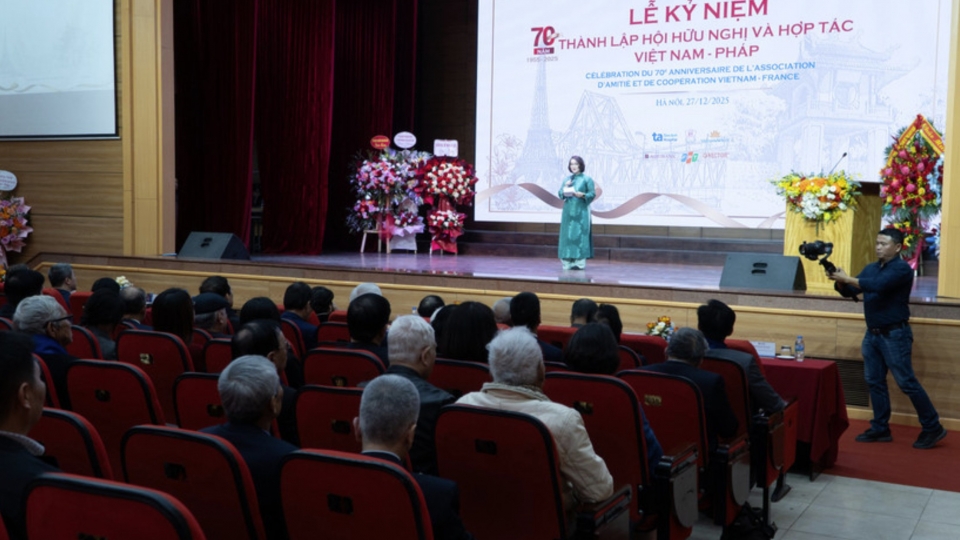
Vietnam-France friendship association marks 70 years of people-to-people ties
VOV.VN - The Vietnam-France Friendship and Cooperation Association has remained keenly aware of its responsibilities, preserving tradition while continuing to innovate and strengthen its role as a bridge between both nations’ people.
