


Party official urges digital overhaul of communication and mass mobilisation work

VOV.VN - A senior Party official has called for a comprehensive overhaul of the information, education and mass mobilisation work, urging greater use of digital technologies, artificial intelligence and strategic policy communication to ensure Party policies are translated more effectively into practice.
Speaking at a nationwide conference in Hanoi on July 2 to review the sector’s performance in the first half of 2026 and outline priorities for the remainder of the year, Politburo member and Head of the Party Central Committee’s Commission for Information, Education and Mass Mobilisation Trinh Van Quyet noted that the sector must modernise both its mindset and working methods to meet the demands of the digital era.
Comprehensive reform from mindset to implementation
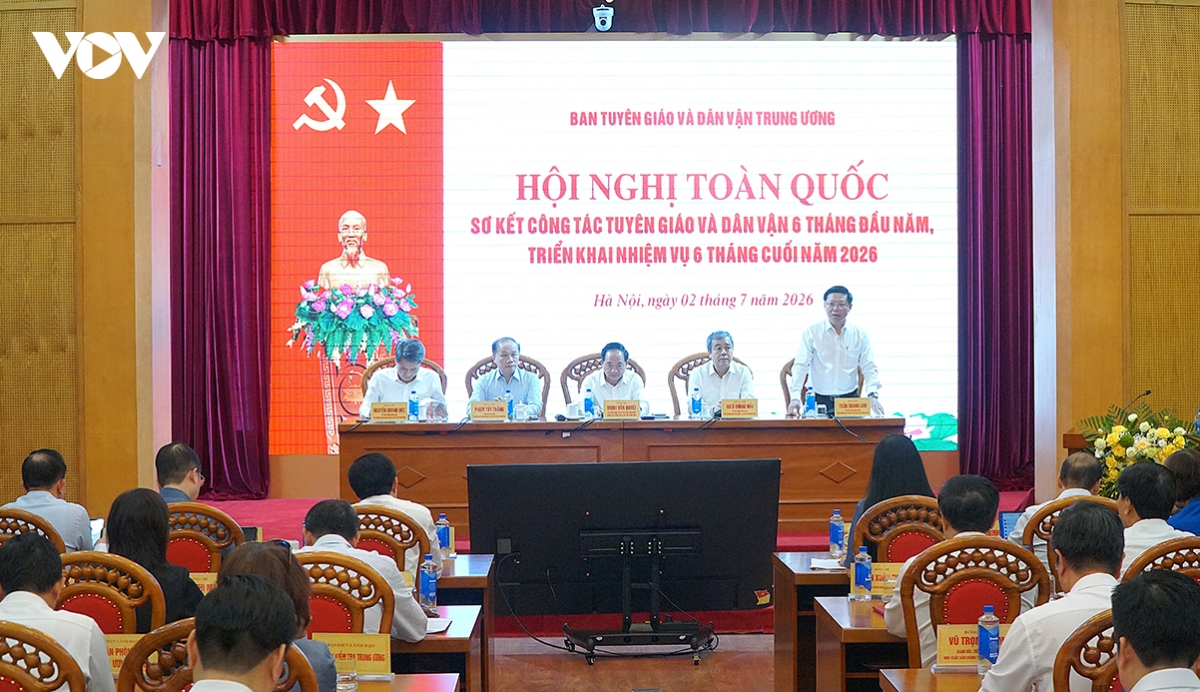
According to reports presented at the conference, the sector has accelerated reforms in strategic policy advice, theoretical research and practical reviews while improving coordination across communication, ideological work, culture and mass mobilisation.
Following the 14th National Party Congress, agencies nationwide have actively implemented action programmes and strategic initiatives to realise the Congress’s Resolution. Localities have also introduced numerous action plans to support socio-economic development and improve policy implementation.
Public communication has increasingly adopted a multi-platform approach, combining traditional and digital channels, alongside expanding the application of new technologies. Communication efforts surrounding the implementation of the 14th National Party Congress’s Resolution, elections to the 16th National Assembly and People's Councils, as well as the rollout of Vietnam’s two-tier local government model, have helped strengthen public awareness and consensus.
Policy communication must stay ahead

In his remarks, Head of the Party Central Committee’s Commission for Information, Education and Mass Mobilisation Trinh Van Quyet stressed that policy communication should move beyond one-way dissemination towards explanation, dialogue and persuasion.
He said communication strategies should be prepared from the earliest stages of policymaking, particularly for policies directly affecting people and businesses, to prevent information gaps that could allow misinformation or rumours to spread.
He also urged agencies to improve the quality of strategic advice, accelerate key policy proposals and strengthen coordination among publicity, theory, journalism, culture and external information work.
A central message of his address was the need for the sector to master cyberspace and harness artificial intelligence in ideological and communication work.
He called on news organisations to uphold professional standards, resist the influence of social media trends and avoid excessive commercialisation of content, while continuing to play a leading role in guiding public opinion and safeguarding the Party’s ideological foundation.
At the same time, he urged further reforms in mass mobilisation, public opinion research, ethnic and religious affairs, and efforts to strengthen public trust as Vietnam continues implementing its two-tier local administration model.
Supporting socio-economic development
At the conference, delegates lso shared local experiences showing that effective mass mobilisation has contributed to resolving bottlenecks in land clearance, administrative reform and major infrastructure projects.
In Hai Phong alone, more than 2,000 community engagement initiatives and hundreds of dialogue sessions with residents and businesses have helped reduce complaints, resolve obstacles and accelerate project implementation, supporting local economic growth.
Concluding the conference, the Party official instructed agencies to immediately translate assigned tasks into concrete action plans with clearly defined responsibilities, timelines and measurable outcomes.
He called for an end to delays in implementation and emphasised that every policy should produce tangible results, with clear accountability to ensure Party decisions are effectively carried out.
Vietnamese press urged to lead information and shape public discourse
VOV.VN - Vietnamese media organisations have been called on to embrace a major shift in mindset, moving beyond their traditional role as information providers to become information leaders that help shape public discourse, contribute to policymaking, and strengthen Vietnam’s presence in the digital information space.


