


VIFC aims to attract US$10-30 billion in international capital annually

VOV.VN - Deputy Prime Minister Nguyen Van Thang has signed a decision issuing the operational regulations for the Vietnam International Finance Center (VIFC), establishing the legal foundation for its two centers in Ho Chi Minh City and Da Nang City to enter operation, and creating a new capital channel capable of attracting US$10-30 billion in international investment each year.

According to Assoc. Prof. Dr. Nguyen Huu Huan, Vice Chairman of the Executive Board of VIFC-Ho Chi Minh City, Vietnam’s development investment needs for the 2026-2030 period are estimated at a minimum of VND38.5 quadrillion (equivalent to 40% of GDP). Meanwhile, the state budget can meet only about 20% (over VND7.7 quadrillion), leaving more than VND30 quadrillion, averaging roughly VND6.16 quadrillion annually, to be raised from non-state sources, including businesses, capital markets, and international channels.
Currently, bank credit outstanding in Vietnam equals 145% of GDP, placing the country among those with the highest credit-to-GDP ratios globally. Heavy reliance on short-term bank deposits for medium- and long-term lending poses systemic risks during external shocks. Although stock market capitalization has reached 82.3% of GDP, its capacity to supply new capital through IPOs, secondary share issuances, corporate bonds, or connections with international institutional investors remains limited relative to economic demand.
In response, the National Assembly issued Resolution 222/2025/QH15 and the Government issued Decree 323/2025/NĐ-CP setting up the VIFC in Ho Chi Minh City and Da Nang.
Rather than replacing commercial banks or the stock market, the center creates channels currently lacking full supply, including foreign and multi-currency funds, long-term capital, private credit, project finance, international bonds, and investments from pension, insurance, and sovereign wealth funds.
The VIFC also serves as a key tool to achieve the targets under Resolution 10-NQ/TW, which aims to attract US$200-300 billion in registered FDI (US$40-50 billion annually) and US$150-200 billion in disbursed FDI (US$30-40 billion annually) over the 2026-2030 period.
During the seven-month period, Vietnam registered over US$38 billion in total foreign capital (up 58% year-on-year) and US$15.20 billion in disbursed capital (up 11.8% compared to the same period in 2025).
The World Investment Report 2026 by the United Nations Conference on Trade and Development (UNCTAD) indicates that the top 20 economies absorb over 80% of global FDI, a list that does not yet include Vietnam. However, next-generation FDI flows are concentrating on strategic fields such as AI infrastructure, semiconductors, critical minerals, and energy transition technologies, all key areas Vietnam is actively developing.
Compared to more than 120 financial centers worldwide, particularly major regional hubs like Singapore and Hong Kong (China), the VIFC benefits from its central position in Southeast Asia and a distinct time zone relative to 21 of the world’s largest financial centers.
This time-zone difference offers a unique advantage, allowing the center to capture idle capital while major global markets are closed. As a latecomer, the VIFC does not compete directly with established hubs, but positions itself as a new center leveraging modern technology and lessons from predecessors to absorb shifting international capital.
Regarding growth impacts, the VIFC Executive Body has modeled three annual GDP contribution scenarios: under the conservative scenario, mobilizing US$10 billion with a 50% disbursement rate (VND130 trillion in real capital) would add VND28.9 trillion to GDP; under the baseline scenario, raising US$20 billion with a 60% disbursement rate (VND312 trillion in real capital) would generate an additional VND69.3 trillion in GDP; and under the accelerated scenario, securing US$30 billion with a 70% disbursement rate (VND546 trillion in real capital) would boost GDP by VND121.3 trillion.
In addition to direct quantitative impacts, the VIFC generates three qualitative effects: extending capital maturities and reducing maturity risks for the banking system; lowering capital costs through competition, credit ratings, and transparency; and encouraging higher standards in corporate governance, financial reporting, and ESG practices.
These structural improvements will boost total factor productivity and economic resilience, outweighing the absolute volume of capital itself, while safeguarding national financial security early on and supporting double-digit growth objectives.
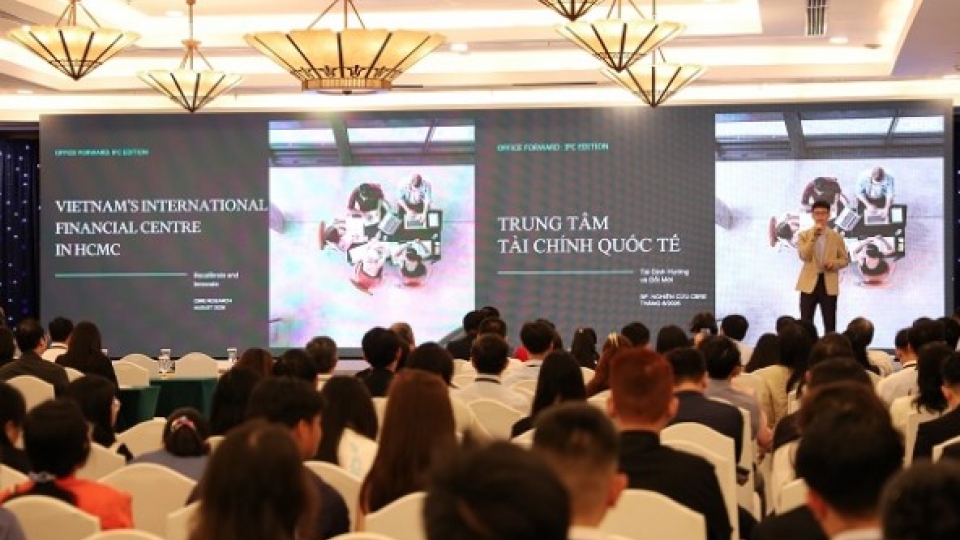
VIFC-HCMC secures US$20 billion in investment commitments
VOV.VN - After six months of operation, the Vietnam International Financial Centre in Ho Chi Minh City (VIFC-HCMC) has attracted around US$20 billion in investment commitments, as it moves to build new market infrastructure and improve access to international capital.
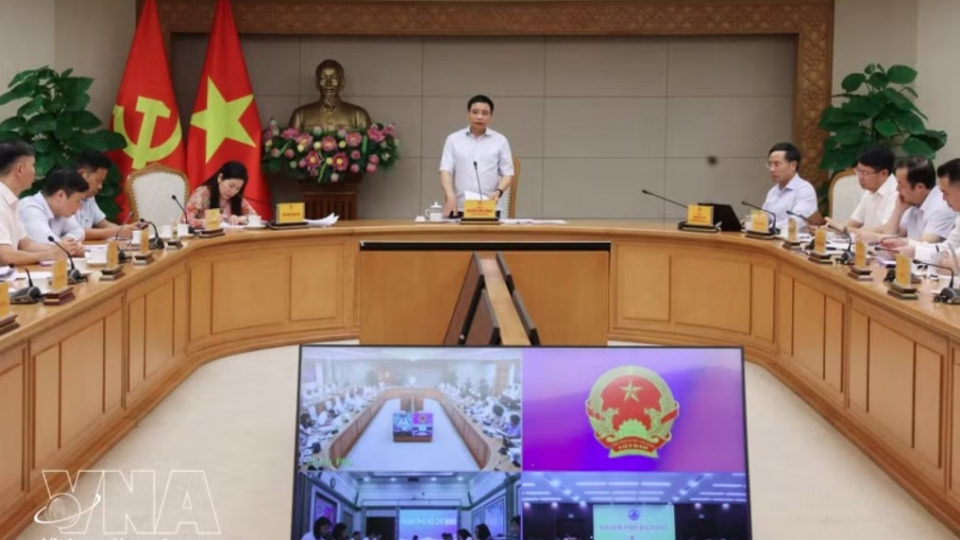
VIFC urged to prioritise products generating real transactions
Deputy Prime Minister Nguyen Van Thang has asked the Vietnam International Financial Centre (VIFC) to prioritise financial products capable of generating actual transactions and attracting medium- and long-term capital for the economy.


