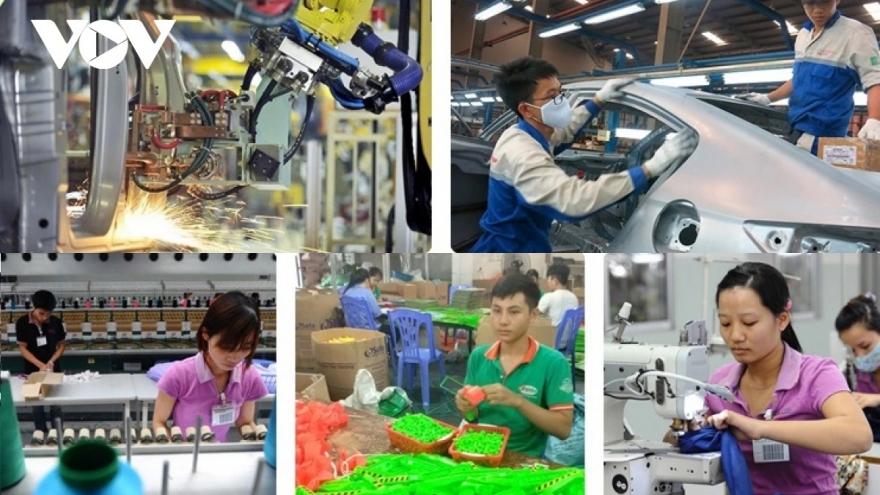
Vietnam’s export-led growth leaves little value at home

VOV.VN - Despite strong gains in industrial output and a surge in newly established businesses, the Vietnamese economy continues to face a paradox: exports are expanding, but the value retained at home remains low.
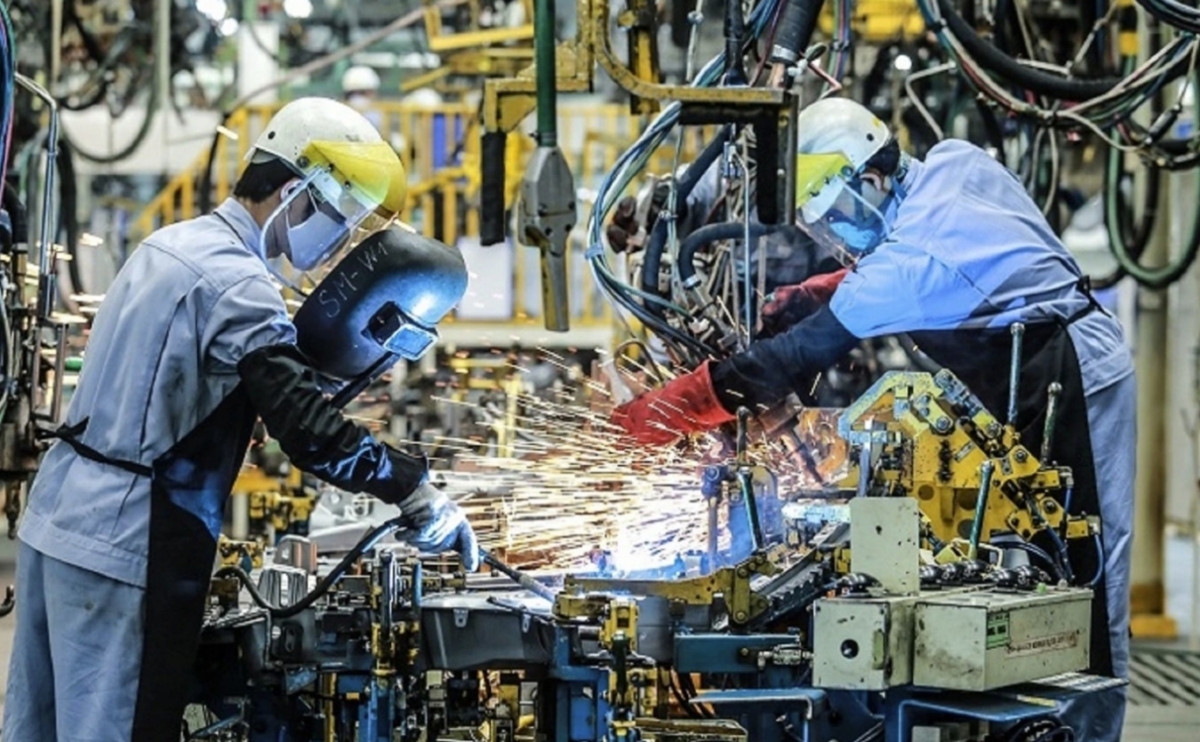
Heavy reliance on foreign direct investment (FDI) and a long-standing subcontracting model is increasing the risk of a middle-income trap unless the growth model shifts in time.
Domestic capacity gaps behind production expansion
According to data from the General Statistics Office under the Ministry of Finance, Vietnam’s industrial production index (IIP) rose 9.2% year on year in 2025, higher than the 8.2% increase recorded in 2024. The number of newly registered firms and businesses returning to operation reached 297,500, up 27.4% from 2024. Expanding output, larger business scale and rising investment inflows point to a strong growth foundation.
Yet sizeable gaps remain beneath the surface of the production sector. Vietnam currently has nearly 7,000 supporting-industry enterprises, concentrated in mechanical engineering, automobiles, electrical and electronic equipment, textiles and high-tech manufacturing. Only around 300 participate in supply chains of major global groups such as Samsung, Honda, Toyota and LG. Localization rates in many industries remain at just 30-40%, far below the government’s target of 50-60%.
At a deeper level, the traditional subcontracting model leaves Vietnamese firms almost entirely dependent on foreign partners’ requirements and standards. Companies receive designs and manufacture to order, without control over product strategy or pricing, keeping profit margins persistently narrow. When raw-material prices or logistics costs fluctuate, firms often have to absorb the increases themselves rather than pass them on to buyers.
Risks intensify when companies rely on only a small number of major clients. A single decision by a partner to relocate production to a lower-cost country can cause orders to fall abruptly, triggering internal supply-chain disruptions, rising inventories and growing additional costs.
Another structural weakness is limited innovation capacity. Many small and medium-sized enterprises have yet to invest systematically in research and development or product design. Goods leave factories under partners’ brands, without ownership of intellectual property, making it impossible to raise long-term margins. Shortages of skilled design engineers and modern production management further constrain product upgrading.
As economies worldwide tighten environmental standards, raise import taxes and introduce new technical barriers, Vietnam’s low-cost advantage is fading. At the same time, domestic firms remain weak at downstream stages of the value chain, including branding, marketing, retail and after-sales services, allowing value added to accrue largely to international distributors.
Growth cannot rely indefinitely on labor and FDI
According to Associate Professor Pham The Anh, Head of the Economics Faculty at the National Economics University, the share of exports of goods and services in Vietnam’s GDP has risen from below 30% in the early 1990s to more than 80% in recent years, among the highest levels of trade openness globally. A wave of free trade agreements has accelerated exports and attracted strong inflows of foreign direct investment.
In 2025, total registered FDI reached US$38.42 billion, up 0.5% from 2024. However, the value retained domestically remains limited.
Nguyen Duc Hien, Deputy Head of the Central Committee for Policy and Strategy, noted that the FDI sector contributes around 20% of GDP but accounts for more than 71% of export turnover while creating only about 10% of domestic employment. Rising profit repatriation means GDP growth does not translate proportionately into stronger domestic capacity.
Professor Hoang Van Cuong, a member of the Prime Minister’s Policy Advisory Council and the National Assembly’s Committee on Economic and Financial Affairs, offered a stark illustration: “Our exports reach US$500 billion, but Vietnam retains only about US$100 billion, or 20%. In effect, we are generating growth for the rest of the world.”
Reliance on the US and the European Union leaves Vietnamese goods vulnerable to tariff barriers and policy shifts. Without a change in the growth model, Vietnam risks falling into a middle-income trap as the demographic dividend fades.
Repositioning within the global value chain
Experts argue that Vietnam can continue to pursue export-led growth, but its quality must change, with Vietnamese firms capturing a larger share of value in each product sold globally. At the same time, domestic capacity needs to become a central pillar, particularly household consumption and the local business sector. Stronger domestic demand would give firms room to invest over the long term in brands and technology rather than chasing short-term, low-margin orders.
The government has issued several breakthrough resolutions to promote science and technology, innovation, institutional reform and private-sector development, including Resolutions 57, 59, 66 and 68. The immediate challenge is to turn these policies into action, remove legal bottlenecks and create room for more decisive business upgrading.
Vietnam has a window of opportunity to reposition itself in the global value chain, moving from a subcontracting base to a hub for high-tech manufacturing. Raising value, however, will not come from incremental adjustments.
It requires a coordinated strategy in which the state lays the groundwork, enterprises take the initiative to move up, and financial and science-technology systems provide close support.
Only by mastering design, technology and markets can Vietnamese firms break out of the low-value manufacturing cycle, contribute more meaningfully to growth, and move toward the goal of becoming a high-income economy by 2045.
Vietnam to host seminar on export growth strategies
The Ministry of Industry and Trade will hold a seminar on December 16 to discuss ways to keep export growth high and sustainable.
Vietnam targets balanced, sustainable and diversified export growth
VOV.VN - Amid global uncertainties, Vietnam is holding firm to its goal of diversifying export markets, products and import sources, which is seen as the key to sustaining long-term growth.