Vietnam, ASEAN emerge as major export markets for RoK

Vietnam and the Association of Southeast Asian Nations (ASEAN) have emerged as increasingly important export markets for the Republic of Korea (RoK) as the East Asian country accelerates efforts to diversify its trade amid shifting global supply chains.
According to an analysis report on import-export trends during 2021–2025 released by the RoK’s Ministry of Trade, Industry and Energy, the country’s exports to China fell sharply by 19.7% over the five-year period.
Exports to China declined from US$162.9 billion in 2021 to US$155.8 billion in 2022 and US$124.8 billion in 2023, before recovering slightly to US$133 billion in 2024 and US$130.8 billion in 2025, still well below earlier levels.
By product category, structural changes in exports were even more pronounced. In 2025, exports from the RoK to China declined year-on-year in traditional key items, including petrochemicals at US$16.27 billion, down 6.6%; wireless communication equipment at US$7.33 billion, down 6.5%; and general machinery at US$6.28 billion, plunging 62.8%. The decline was attributed to China’s rapidly expanding production capacity, which has intensified competition with the RoK’s core industries.
Despite shrinking exports to China, the RoK’s overall exports continued to grow. In 2025, total exports hit a record high of US$709.7 billion, buoyed by a semiconductor super-cycle driven by the expansion of artificial intelligence and data centres. The US, ASEAN and Vietnam helped offset much of the decline from the Chinese market.
The RoK’s exports to the US surged 28.2% over five years, from US$95.9 billion in 2021 to US$122.9 billion in 2025. With the US imposing reciprocal tariffs and restructuring supply chains, the upward trend is expected to persist.
ASEAN, particularly Vietnam and Thailand, has also stood out. The RoK’s exports to ASEAN rose 12.5% over the period, reaching US$122.4 billion in 2025, while exports to Vietnam climbed 10.8% to US$62.8 billion.
Korean exports to Central and South America also increased from US$25.8 billion to US$31 billion, to the EU from US$63.6 billion to US$70.1 billion, to the Middle East from US$15.6 billion to US$20.4 billion, and to India from US$15.6 billion to US$19.2 billion over the same period.
Vietnamese firms seek to expand high-quality product exports to RoK
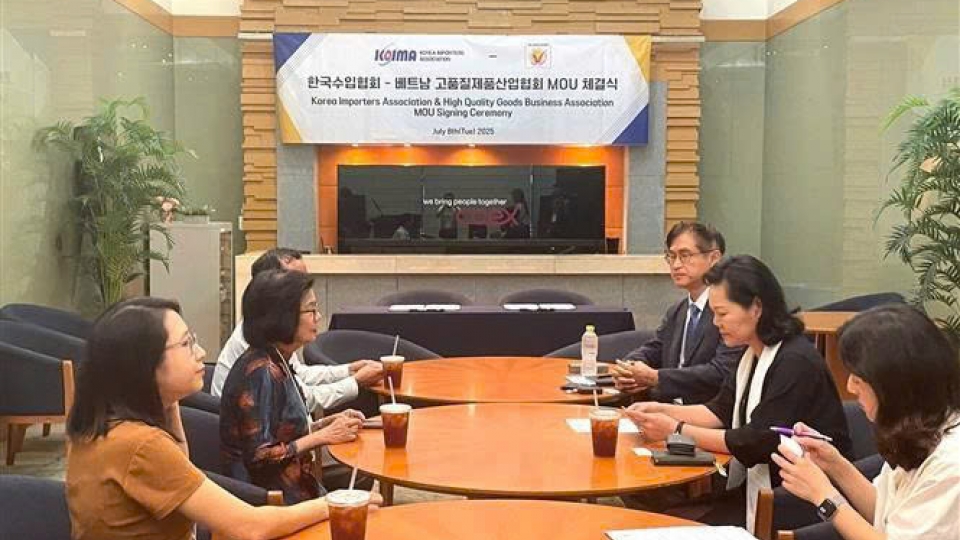
A delegation of the Business Association of High-Quality Vietnamese Products is taking part in the 2025 Korea Import Fair (KIF), held at the COEX Exhibition Centre in Seoul from July 7 to 9.