US easing curbs opens new chapter for Vietnam’s chip industry

VOV.VN - Washington’s move to ease export controls could transform Vietnam from a chip assembly hub into a manufacturing partner and a strategic alternative to China, Rest of World reported.
According to the website, President Donald Trump said on February 20 he would direct relevant agencies to remove Vietnam from a strategic export control list that currently restricts its access to advanced technologies from US companies. He also reiterated Washington’s commitment to supporting a “strong, independent, self-reliant and prosperous” Vietnam.
Sujai Shivakumar, director of the Renewing American Innovation Project at the Center for Strategic and International Studies (CSIS), told Rest of World that the decision signaled a transition for Vietnam within the semiconductor supply chain from a back-end assembly hub to an upstream manufacturing and design partner. He said the US was effectively clearing the path for Vietnam to access high-end American tools and software essential for advanced chipmaking.
He stressed that the move was part of Washington’s broader strategy to deepen ties with Vietnam in the Indo-Pacific region.
In the semiconductor sector, on January 16, 2026, Vietnam's military-run telecom group Viettel broke ground on its first semiconductor fabrication plant at the Hoa Lac Hi-Tech Park, aiming to produce 32-nanometer chips, with trial runs planned for 2027 and full operations in 2028.
The website noted that rather than chasing the most advanced chips, which are now produced using 2- or 3-nanometer processes, Vietnam is focused on building an industry from scratch.
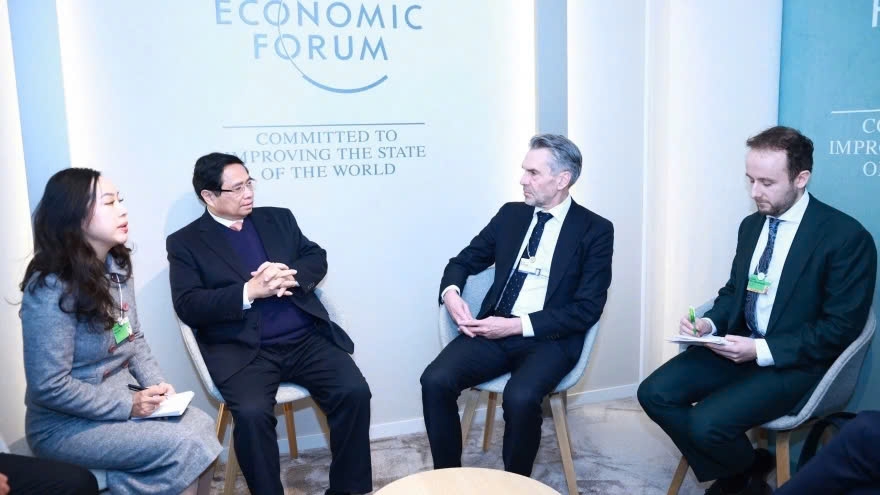
Earlier this year, Prime Minister Pham Minh Chinh met with Eduard Stiphout, a senior vice president at ASML, the Dutch company that makes the machines needed to produce advanced chips.
During a subsequent working session with Deputy Minister of Science and Technology Vu Hai Quan, Stiphout said ASML was studying the possibility of expanding its supply chain in Vietnam, while considering establishing an official presence and supplying equipment to potential customers in the country, thereby contributing to the formation and development of a domestic semiconductor ecosystem.
John Neuffer, President and CEO of the Semiconductor Industry Association (SIA) based in Washington, expressed his impression of Vietnam’s development pace during a January visit to Hanoi for a chip conference. He reminded that many SIA members, including Intel, Samsung Electronics, Qualcomm, Amkor Technology, and Marvell Technology, have already established and expanded operations in Vietnam.
Over the past year, Qualcomm opened its third-largest global R&D centre in Vietnam. Marvell Technology also inaugurated three new offices simultaneously in the country, making Vietnam its third-largest global R&D hub after the United States and India.
In international media coverage, Vietnam’s image is shifting. Once seen primarily as a low-cost outsourcing and semiconductor assembly hub, the country is increasingly viewed as a strategically important link in a reconfiguring global supply chain, edging closer to a role in one of the world’s most valuable industries.
Construction begins on Vietnam’s first chip plant amid international media attention
VOV.VN - Construction has begun on Vietnam’s first semiconductor chip manufacturing plant at Hoa Lac Hi-Tech Park, a development that has attracted coverage from international media as the country seeks to build a domestic chipmaking ecosystem and move up the global technology value chain.