Strengthening internal capacity in SMEs

VOV.VN - Experience in developed economies shows that building “healthy” businesses requires active state policies to strengthen corporate fundamentals. In Vietnam, however, such mechanisms remain constrained by persistent structural bottlenecks.
Policy support as a catalyst
In developed countries, small and medium-sized enterprises (SMEs) are a central focus of state economic policy, reflecting their limited scale, capital shortages and difficulty accessing finance, outdated technology, weak management capacity, shortages of skilled labour and limited access to production land.
In countries such as Japan and the Republic of Korea (RoK), SME support policies are embedded in dedicated framework laws. These include concessional financing for investment in science and technology, innovation and product research and development; support for distribution networks; and procurement policies under which governments and large industrial groups purchase goods and services from SMEs. Collectively, these measures are designed to promote growth and strengthen firms’ internal capacity.
Corporate internal capacity encompasses multiple elements, including finance (capital and cash flow), human resources (skills and workforce), physical assets (machinery and infrastructure), technology (software and intellectual property), as well as brand value and credibility.
Vietnam currently has close to one million enterprises, providing sustainable livelihoods for millions of workers and making a significant contribution to the state budget. Yet financial capacity remains the weakest link, while policies aimed at strengthening corporate fundamentals have yet to deliver practical results, according to Nguyen Quoc Viet, a lecturer at the University of Economics under Vietnam National University, Hanoi.
For SMEs to move up the value ladder, he said, they need substantive policy-driven incentives that address constraints at their root.
“Effective incentives must directly tackle the barriers holding businesses back,” Viet said, citing land policy as an example. He argued that administrative procedures should be streamlined and informal barriers removed to improve access. Access to capital is another major bottleneck, with around 20% of credit flowing into real estate while private enterprises still struggle to secure financing for production upgrades.
Technology as a survival factor
In the current environment, the application of science and technology has become a decisive factor for business survival and growth. Technological adoption helps reduce operating costs, speed up production, improve management efficiency, optimise resources and support product improvement and innovation.
Le Xuan Nghia pointed to slow disbursement from Vietnam’s science and technology development funds, describing the situation as “money available, but unable to be spent”.
He noted that these funds have disbursed only about VND 500 billion despite operating for more than a decade. By comparison, US science and technology funds channel trillions of dollars directly into corporations and research institutions, while Japan has recently launched three technology investment packages worth about US$210 billion. China has committed hundreds of billions of dollars to artificial intelligence and robotics.
“With Vietnam disbursing only around VND 500 billion, it is unrealistic to expect enterprises to develop new technologies,” Nghia said, arguing that the government should directly support private firms in applying science and technology rather than funding research projects that remain on paper years later.
Comprehensive legal reform needed
To strengthen SME capacity, 2026 should see a comprehensive review and overhaul of relevant legislation, starting with amendments to the 2017 Law on SME Support. Other priorities include restructuring SME support funds, such as credit guarantee schemes and SME development funds, as well as science and technology funds at both national and enterprise levels.
Policy directions set out in Resolution 57 and Resolution 68 also need to be fully institutionalised through concrete programmes and measures. Legal reforms should adopt a holistic approach, moving beyond technical adjustments or isolated incentives to reflect a renewed strategic vision for private-sector development.
Le Bo Linh, former deputy head of the National Assembly’s Committee on Science, Technology and Environment, said the state should not only mobilise private-sector resources but also proactively support SMEs with public funding and facilitate their access to national resources to strengthen internal capacity.
Resolution 10, adopted in June 2017, set a target of at least one million active enterprises by 2020. However, the target remained unmet by the end of 2025, according to Le Minh Nghia, chairman of the Vietnam Financial Consultants Association.
Resolution 68 aims for two million enterprises by 2030 and three million by 2045. That would mean adding one million enterprises over 15 years. Yet, Nghia noted, this would still equate to only one enterprise per 50 people, compared with one per 10 in the US.
“This is something that warrants serious reflection,” he said. “The question is how to enable people to operate as businesses in a substantive way, rather than encouraging start-ups as a short-lived movement.”
SMEs, he added, need support not merely to survive, but to grow strong enough to integrate more deeply into domestic and global value chains. That requires policies that encourage investment in technology, management capability, workforce development and sustainable brand-building.
Without policies that genuinely strengthen corporate fundamentals, Vietnam will struggle to reach its targets of 1.5-2 million enterprises in the coming years and 3 million in the longer term.
Japanese investment surge unlocks growth potential for Vietnamese SMEs
VOV.VN - The robust wave of investment from Japan is opening up breakthrough opportunities for Vietnam’s small and medium-sized enterprises (SMEs) as they pursue deeper integration and improved international competitiveness.
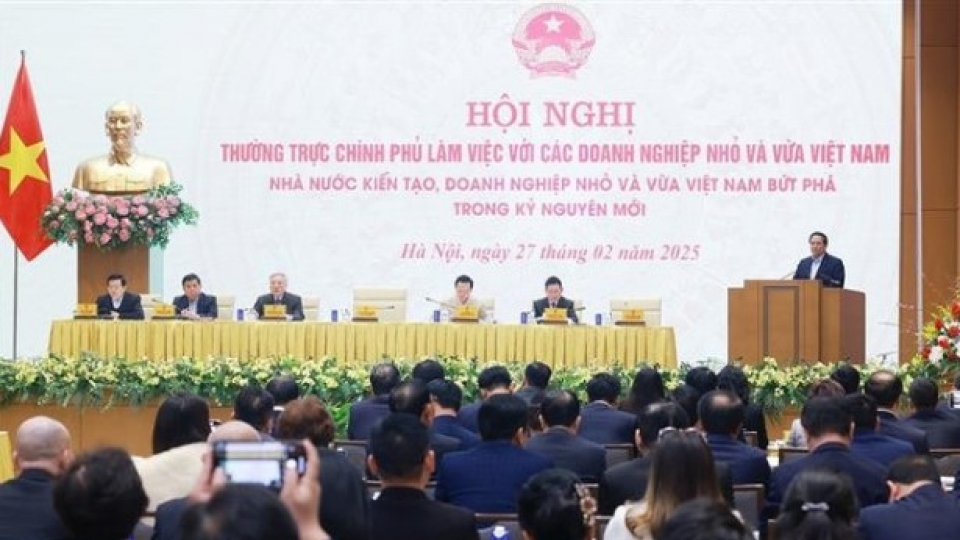
PM Pham Minh Chinh urges SMEs to break limits for growth
Prime Minister Pham Minh Chinh has called on small- and medium-sized enterprises (SMEs) to push beyond their limits and strive for growth at a Government conference with the group on February 27.