Opportunities and growth potential for Vietnamese banh chung

VOV.VN - From a traditional Lunar New Year (Tet) dish, banh chung (a square glutinous rice cake traditionally made for Tet) is gradually evolving into a marketable product with considerable economic potential.
Creativity in preparation, standardization under the OCOP program (One Commune One Product, a national rural development program), and changing consumer demand are opening up opportunities for commercialization, allowing Vietnam’s culinary heritage to become more deeply integrated into market value chains.
From tradition to distinction
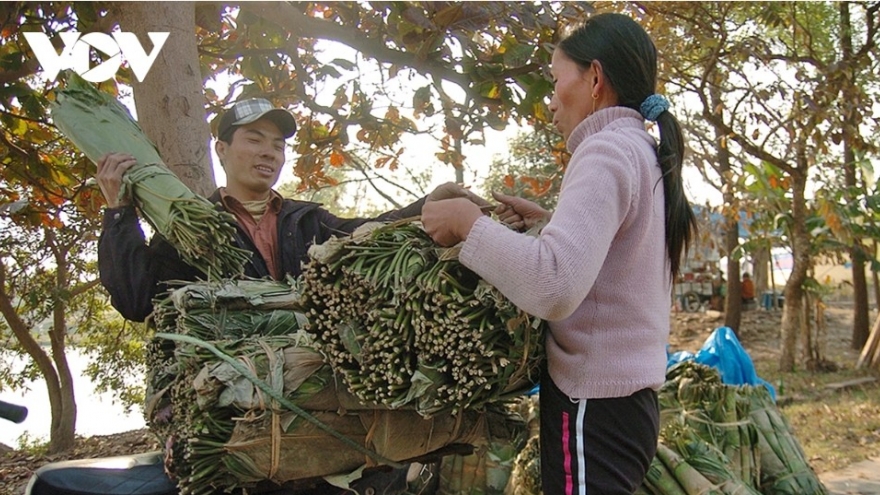
For residents of Phu Son commune in the former Ba Vi district, now Vat Lai commune in Hanoi, banh chung wrapped in sugarcane leaves has long been a traditional cultural practice, preserved and passed down through generations. On important occasions such as Lunar New Year holidays, weddings and village festivals, the dish is considered indispensable on ceremonial trays.
Phung Thi Cam, now in her seventies, said she first saw her grandparents and parents making sugarcane-leaf banh chung when she was seven, during the traditional Lunar New Year. The sugarcane leaves used for wrapping must be at the right stage, not too young and not too old, to preserve their aroma. After being harvested, the leaves are washed and briefly blanched in hot water to give them sufficient toughness and flexibility for wrapping.
“The ingredients remain the same as for traditional banh chung: glutinous rice soaked thoroughly, pork lightly seasoned with salt, and green beans that are steamed, mashed and mixed with pepper,” Cam said. “The wrapping requires great care because sugarcane leaves are small and long. The wrapper must carefully layer the leaves to create a tight sheet before adding the rice, beans and pork, then roll it firmly. This step is crucial, only when wrapped tightly does the cake take on an even shape and prevent the rice from slipping through gaps in the leaves.”
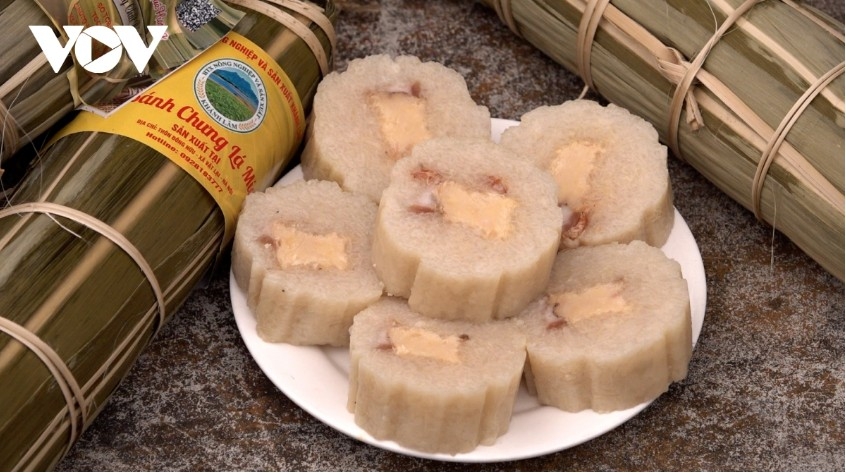
Like traditional banh chung, sugarcane-leaf banh chung is boiled over a wood fire for at least eight to 10 hours. When cooked, the cake takes on an off-white color and carries a mild, fresh sugarcane aroma. A subtle sweetness from the leaves permeates the glutinous rice and beans, blending with the pork to create a distinctive flavor.
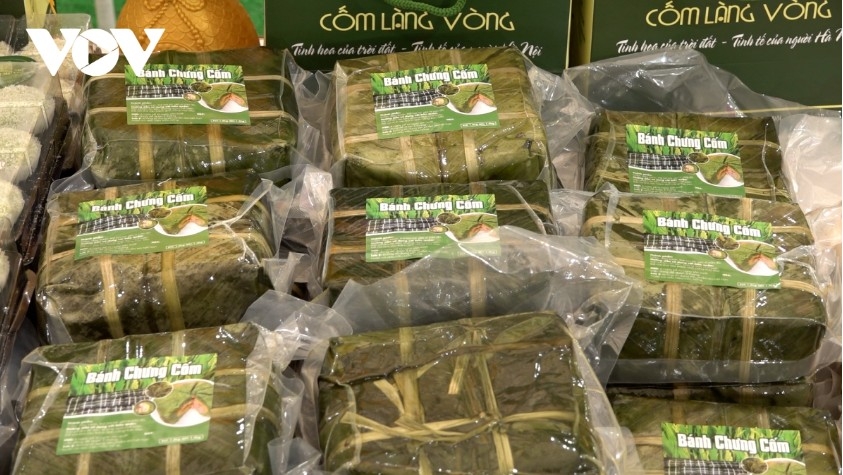
Alongside sugarcane-leaf banh chung, banh chung made with com (young green rice flakes) has also gained popularity in recent years. Nguyen Thi Thu Huyen, Director of Viet Long Investment and Trading Development JSC, which specializes in com-based foods, said the company adapted the traditional banh chung to create com banh chung in order to diversify flavors and attract consumers.
“The ingredients include dried or fresh com mixed with high-quality upland glutinous rice, along with green beans and pork, all wrapped in dong leaves,” Huyen said. “The ratio between com and rice has to be precise. Too much com makes the cake mushy after boiling and causes it to lose its shape; too little and it no longer qualifies as com banh chung. The usual ratio is six parts glutinous rice to four parts com.”
She noted that com banh chung has a distinct aroma of young rice and a soft, elastic texture. “Traditional banh chung often hardens after a few days—a phenomenon known as ‘lai gao’—losing its characteristic softness and stickiness. Com banh chung does not experience this and retains its elasticity even after several days,” she said.
From the traditional banh chung, creativity has produced distinctive variations that preserve the original flavor while creating difference, thereby generating economic value for those who maintain and develop the craft. However, for traditional cultural values to endure over time, supportive policies are needed to encourage and sustain such economic value.
Promoting economic value
As modern life accelerates, many traditional cultural practices risk fading. Banh chung, however, remains an essential dish on Lunar New Year tables, recalling memories of earlier hardships endured by previous generations and childhood scenes of families gathering to watch pots of banh chung cooking over a wood fire.
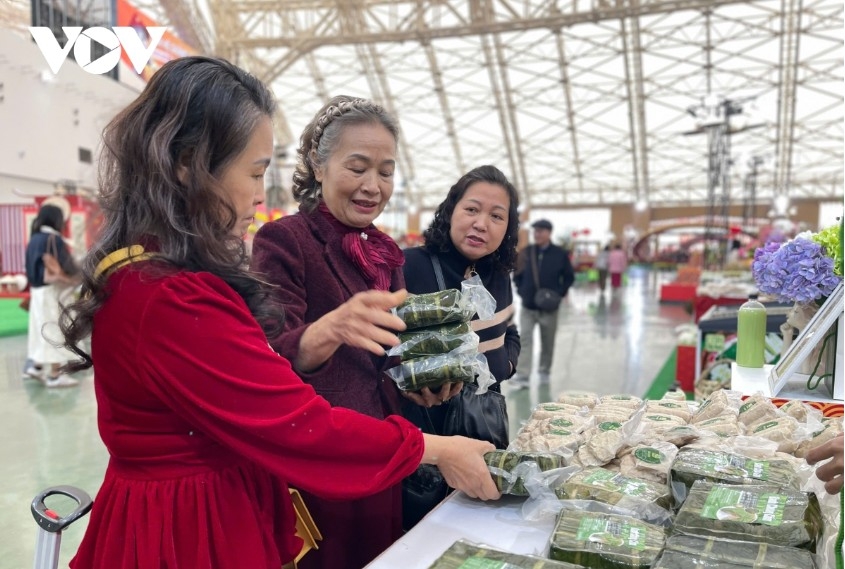
Phung Thi Xuan, head of business at Khanh Lam Agricultural and Production Cooperative in Vat Lai commune, said sugarcane-leaf banh chung has long been a traditional feature of the former Phu Son commune but gradually declined over time. In recent years, the cooperative has revived the product, which has now been recognized as a three-star OCOP product.
“This means sugarcane-leaf banh chung has created a certain level of economic value, and once that value exists, the tradition is less likely to fade,” Xuan said.
“However, for both economic and cultural value to be sustainable, we need state support in the form of preferential-interest capital to invest in science, technology and modern machinery, and to expand production facilities.”
She added that the cooperative hopes to invest in preservation technology to extend shelf life and enable wider distribution so consumers across the country can enjoy the product. “State support is the motivation that allows us to persist over time in preserving traditional cultural practices. Without it, even with the desire to do so, it would be difficult for local people to safeguard the core traditions of their homeland,” she said.
According to Pham Dinh Khue of Hanoi Architectural University, Vietnamese cuisine also serves as a “cultural ambassador,” helping promote the country’s image and bring Vietnamese culture closer to international friends.
“The appeal of Vietnamese cuisine lies not only in its diversity and uniqueness, but also in its harmonious combination of traditional culinary art and nutritional value,” Khue said. He argued that the state should develop preferential policies and financial support for those seeking to maintain and promote traditional cultural values, while encouraging international cultural cooperation and the development of tourism activities linked to craft villages, festivals and culinary experiences. Such efforts, he said, could generate sustainable economic value while ensuring that traditional culture is preserved rather than eroded.
Traditional culture represents a system of material and spiritual values formed and transmitted across generations. Thanks to innovation and creativity, these values have been preserved to the present day.
In the context of deeper integration, traditional culture has become a core element helping Vietnam assert its distinctiveness and uniqueness. Greater investment and attention from the state and local administrations are needed to enable traditional cultural practices to spread more widely and reach the regional and global level, thereby reinforcing Vietnam’s distinct identity.
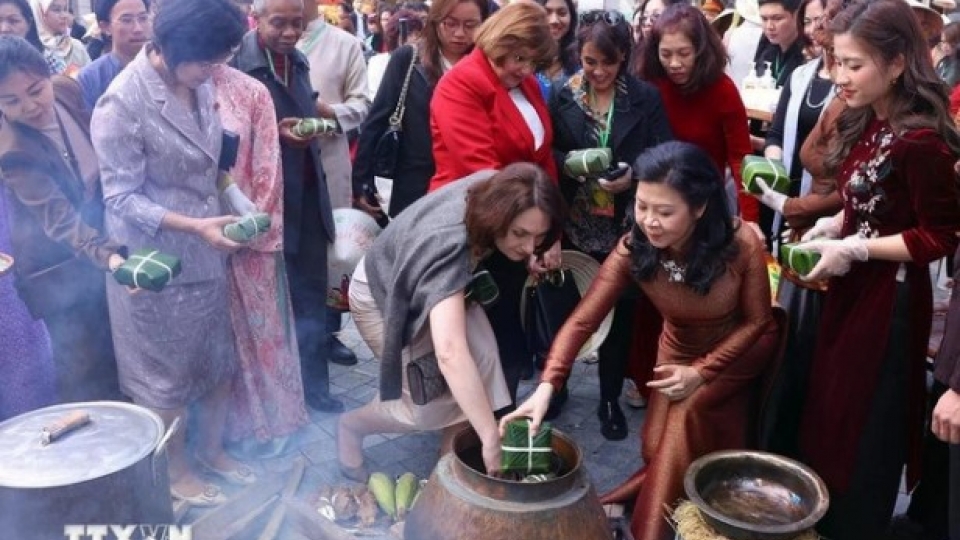
Party chief’s spouse, foreign female ambassadors wrap ‘banh chung’
The spouse of the Party General Secretary, Ngo Phuong Ly, on January 16 joined female ambassadors and diplomats of foreign countries in Hanoi in wrapping ‘banh chung’ (glutinous rice cake) – a traditional dish on the occasion of Vietnam's Lunar New Year (Tet) festival.