


Main consultancy contractor selected for North-South high-speed railway project

VOV.VN - A consortium of firms from Vietnam, France and the Republic of Korea (RoK) has been selected for Package TV-02, covering survey, feasibility study preparation, front-end engineering design (FEED) and bidding document preparation, the key consultancy package for Vietnam's North-South high-speed railway project.
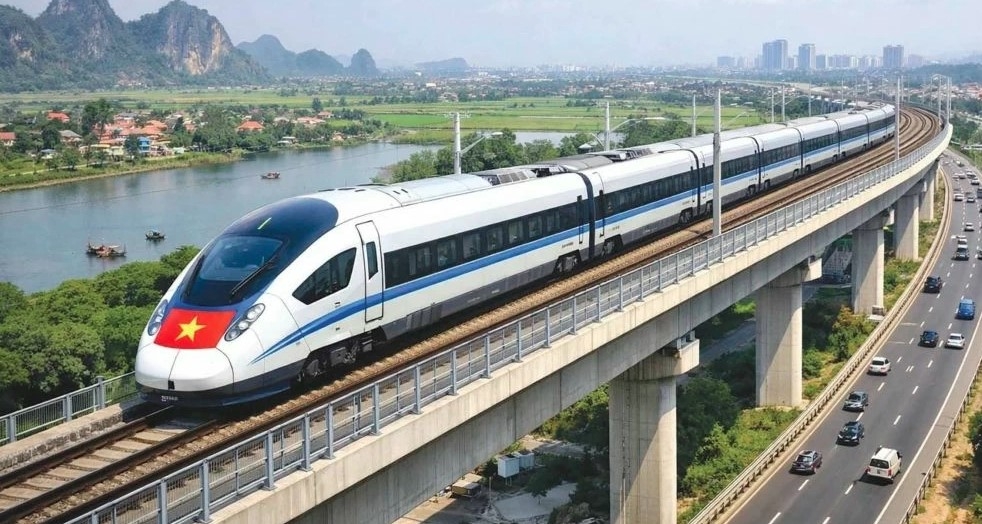
The Thang Long Project Management Board under the Ministry of Construction issued Decision No. 3456 approving the contractor selection result for Package TV-02. The winning consortium won the package at a winning price of about US$400 million for a 30-month implementation period.
The consortium comprises SYSTRA of France as lead member; Sambo Engineering Co., Ltd (SAMBO), Yooshin Engineering Corporation (Yooshin) and Korea National Railway (KNR) of the Republic of Korea (RoK); and four Vietnamese firms: Transport Engineering Design Inc. (TEDI), Transport Engineering Design Inc. South (TEDI SOUTH), Transport Investment and Construction Consultancy JSC (TRICC) and Hoang Long Construction Consultancy JSC (HOANG LONG).
TEDI Chairman Pham Huu Son says Vietnamese contractors, particularly TEDI, will take on a substantial workload under Package TV-02 after gaining design consultancy experience on the Hanoi-Quang Ninh high-speed railway project. Following the announcement of the selection result, the consortium and the Thang Long Project Management Board will hold negotiations as a basis for signing the contract.
Package TV-02 has an estimated value of around US$420 million and uses standard international direct appointment, offline bidding, and single-stage single-envelope selection. It involves a fixed unit-price contract for survey work and a lump-sum contract for feasibility study preparation, FEED and bidding document preparation over 30 months.
Under the requirements, the consultancy must produce a technically and economically reliable feasibility study to inform investment decisions, while finalizing FEED and bidding documents for subsequent construction packages. Findings on technology, investment options, financing and project efficiency will also help assess non-state capital mobilization, including participation by domestic and foreign investors under public-private partnerships (PPP) if investment efficiency and cost-recovery conditions are met.
The contractor is also required to ensure compatibility across the railway system and related infrastructure, conduct accurate surveys and collect reliable baseline data, coordinate closely with stakeholders, and comply with Vietnamese regulations and international practices. Given the unprecedented scale and technical complexity of high-speed rail in Vietnam, Package TV-02 must establish a reliable technical, technological and organizational foundation for the project and future high-speed rail development in the country.
Spanning about 1,541 km from Ngoc Hoi station in Hanoi to Thu Thiem station in Ho Chi Minh City, the project runs through 15 provinces and municipalities under current administrative boundaries. It will be built as a new double-track 1,435 mm gauge line with a design speed of 350 km/h and an axle load of 22.5 tonnes, featuring 23 passenger stations and five freight stations along with synchronized rolling stock and equipment.
Designed for passenger transport while meeting dual-use defense and security needs and capable of freight transport when required, the project has a preliminary total investment of US$67.34 billion) and is scheduled for implementation in the 2025-2035 period.
North-South high-speed railway targeted to break ground in Dec. 2027
VOV.VN - Vietnam is accelerating preparations for its 1,541-km North-South high-speed railway, a project estimated to cost more than US$67 billion and targeted for groundbreaking in December 2027, with the full line expected to be substantially completed by 2035.


