Low-emission rice paves the way for higher-value rice exports

VOV.VN - After two years of implementing the programme to develop one million hectares of high-quality, low-emission rice, rice production in the Mekong Delta is shifting toward greener practices, thereby opening opportunities to raise the value of rice exports.
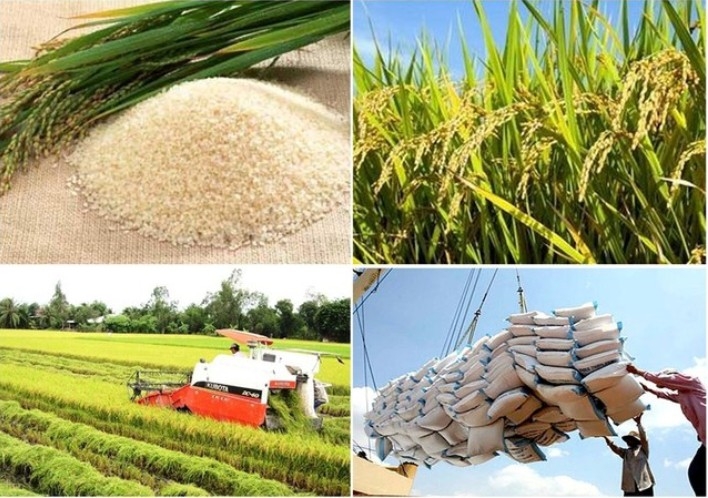
Green rice gradually enters export markets
The Prime Minister approved the project titled “Sustainable development of one million hectares of specialised high-quality, low-emission rice associated with green growth in the Mekong Delta to 2030” under Decision No. 1490 on November 27, 2023. More than two years into implementation, the reorganisation of production along value chains has recorded several positive changes.
According to the Ministry of Agriculture and Environment, the area cultivated with high-quality, low-emission rice has reached about 354,839 hectares, equivalent to 197% of the target for the initial phase of the project.
Alongside the expansion of cultivated area, farmers’ production practices are gradually shifting toward reducing emissions, raising value and protecting the environment. Sustainable farming practices, including improved irrigation management, appropriate fertiliser use and post-harvest straw treatment, are being applied more widely.
At pilot models guided by the Ministry of Agriculture and Environment, the seeding rate has fallen by about 45%, fertiliser use by 30%, and the number of pesticide sprayings by two to three times per crop. Irrigation water use has declined by around 20% thanks to the alternating wetting and drying irrigation method.
As a result, rice yields have increased by about 12%, input costs have dropped by around 40%, and farmers’ profits have risen by an average of VND6 million per hectare per crop. Greenhouse gas emissions have also fallen by about 3-4 tonnes of CO₂ per hectare per crop.
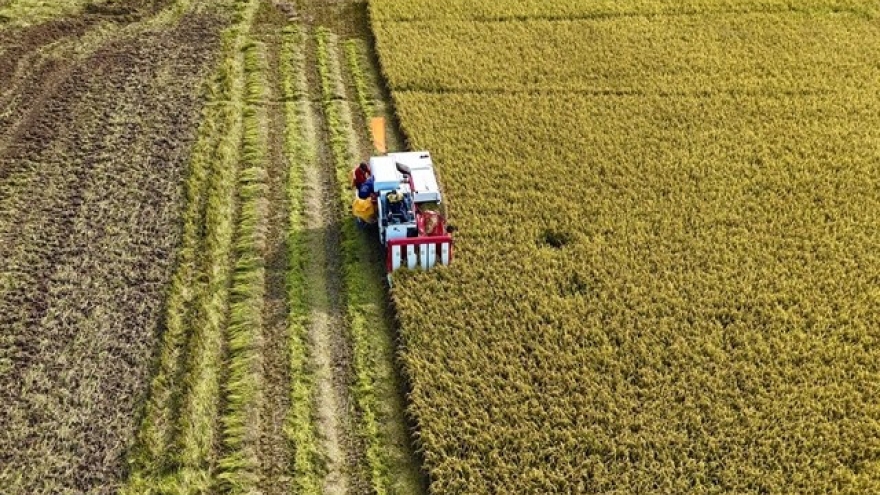
Mechanisation in rice production has also expanded rapidly. At pilot sites, 100% of land preparation and harvesting has been mechanised, while other stages increasingly use rice transplanters, row seeders and unmanned aerial vehicles.
A total of 1,129 cooperatives and cooperative groups and more than 210 enterprises are participating in the programme. Around 600 cooperatives have signed production-and-consumption agreements with enterprises, covering 60-70% of the programme’s area.
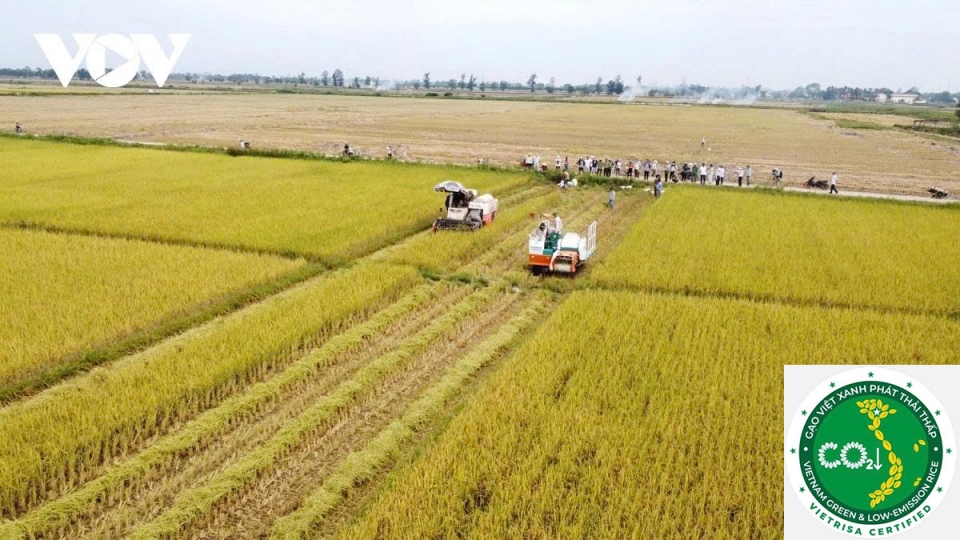
Alongside changes in production practices, efforts to build a green rice brand are also under way. The Vietnam Rice Industry Association has begun developing the label “Vietnam green low-emission rice.”
So far, rice cultivated under this label covers more than 18,000 hectares, corresponding to an output of about 75,000 tonnes of rice. Of this amount, 500 tonnes have been exported to Japan, one of the world’s most demanding markets for food quality.
Le Thanh Tung, Vice Chairman and General Secretary of the Vietnam Rice Industry Association, said that as cultivated area continues to expand, the output of low-emission rice could double to about 150,000 tonnes in the coming period.
“Reducing emissions does not make rice grains tastier, but it certainly strengthens the brand. When the national brand becomes stronger, the competitiveness of Vietnamese rice in international markets will also improve,” Tung said.
From an international perspective, Dr. Jongsoo Shin, Regional Director for Asia at the International Rice Research Institute (IRRI), said the one-million-hectare rice programme is among the most forward-looking and effective policies in the ASEAN region.
According to Shin, the programme has moved from the stage of ideas to concrete results in the field, providing clear scientific evidence of the effectiveness of low-emission rice production models.
Toward green Vietnamese rice brand
Despite opportunities to raise value, the global rice market continues to fluctuate. In the first two months of 2026, Vietnam exported about 1.3 million tonnes of rice worth US$599.3 million, up 5% in volume but down 11.2% in value compared with the same period last year.
The average export price stood at about US$464 per tonne. The Philippines remained the largest market for Vietnamese rice, accounting for 47.6% of exports, followed by China and Ghana.
Speaking at a conference reviewing two years of the programme’s implementation held on March 8, Minister of Agriculture and Environment Tran Duc Thang said the initiative presents an important opportunity to reshape Vietnam’s rice sector toward a greener, more sustainable and environmentally responsible direction.
According to the minister, the programme not only aims to raise productivity and farmers’ incomes but also contributes to Vietnam’s commitment at COP26 to achieve net-zero emissions by 2050.
However, implementation still faces several challenges, including inadequate intra-field irrigation infrastructure, limited production organisation capacity among some cooperatives, and financial resources for low-emission farming models that remain insufficient.
In the coming period, ministries, sectors and localities have been asked to step up investment in irrigation infrastructure, expand sustainable farming models, strengthen links among enterprises, cooperatives and farmers, and promote green credit for high-quality rice production.
Minister Tran Duc Thang said that if implemented in a coordinated manner, the one-million-hectare high-quality, low-emission rice programme will provide the foundation for building a Vietnamese rice brand that is green, clean, high-quality and sustainable, thereby strengthening the position of Vietnamese rice in the global market.
Low-emission rice seen as pathway to strengthen Vietnamese rice brand
VOV.VN - Expanding low-emission rice production could help Vietnam meet its climate commitments while strengthening the global competitiveness and branding of its rice exports, industry experts said at a workshop in Hanoi on January 23.
Vietnam transforms rice industry as its low-emission rice gains global traction
VOV.VN - The recent successful establishment of the Vietnam Green & Low-Emission Rice brand not only helps elevate the value of Vietnamese rice but also meet the stringent requirements of international markets, offering lasting benefits for both businesses and rice growers.