


German executive recommends Vietnam shift to innovation-driven growth

Vietnam must move beyond manufacturing-led growth and make innovation a key economic driver to sustain its competitiveness and secure long-term growth, German banking executive Jens Ruebbert has said.

Ruebbert, Asia-Pacific Regional Head of Landesbank Baden-Wuerttemberg (LBBW) and Chairman of the EU–ASEAN Business Council, said Vietnam has maintained impressive growth for years, steadily strengthening its position in global supply chains and emerging as a leading Southeast Asian destination for European companies seeking to expand.
The International Monetary Fund forecasts Vietnam's economy will surpass US$600 billion by 2030, reflecting increasingly solid growth fundamentals, he noted.
Vietnam's transformation over the past two decades has been remarkable, shifting from an agriculture-based economy towards industrialisation and deep global trade integration. Its participation in numerous free trade agreements, including the EU–Vietnam Free Trade Agreement (EVFTA), has helped expand market access and boost competitiveness.
Exports have nearly tripled over the past decade to US$473 billion, with higher-value products such as computers, electronics and machinery gaining prominence over traditional products such as textiles and phones. This shift signals stronger manufacturing capabilities and deeper participation in higher value-added segments of global supply chains, Ruebbert said.
Foreign investment remains a major growth engine. Registered investment reached US$50.4 billion in the first nine months of 2026 while disbursed foreign direct investment (FDI) totalled US$21 billion. This is an important resource for accelerating industrial transformation and laying the groundwork for future growth, he noted.
Vietnam's appeal is also reflected in European business sentiment. He cited the EU–ASEAN Business Council's annual survey as finding that 64% of surveyed companies identify Vietnam as a preferred destination for business expansion in Southeast Asia. However, they also hope that the EU will further increase its presence and level of engagement with the region, beyond the existing framework for trade cooperation.
Ruebbert, who spent four years living and working in Vietnam, said the country could benefit further from global supply chain diversification as companies seek alternative production bases to reduce dependence on a single market and enhance adaptability to changes. Semiconductors and the digital economy also offer significant opportunities to generate new growth momentum.
However, he warned that reliance on foreign capital and technology, relatively low R&D spending and gaps in innovation capacity could constrain Vietnam's ambitions. US trade and tariff policies also pose challenges to its economy while competition from China and other ASEAN economies is intensifying.
To maintain its edge, Vietnam must accelerate regulatory and governance reforms, increase investment in research and development, strengthen its capacity to manage risks, and ensure more efficient cross-border financial connectivity, he said.
The country should also deepen economic ties with Germany, particularly in trade and investment. While bilateral trade continues to expand, German exports to Vietnam still have considerable room to grow. Vietnam currently ranks 21st among Germany's export markets.
Ruebbert stressed that Vietnam has the potential to go beyond being an alternative manufacturing hub in the region. Its next growth phase must focus on industrial capacity upgrading, domestic market development and a more solid foundation for innovation.
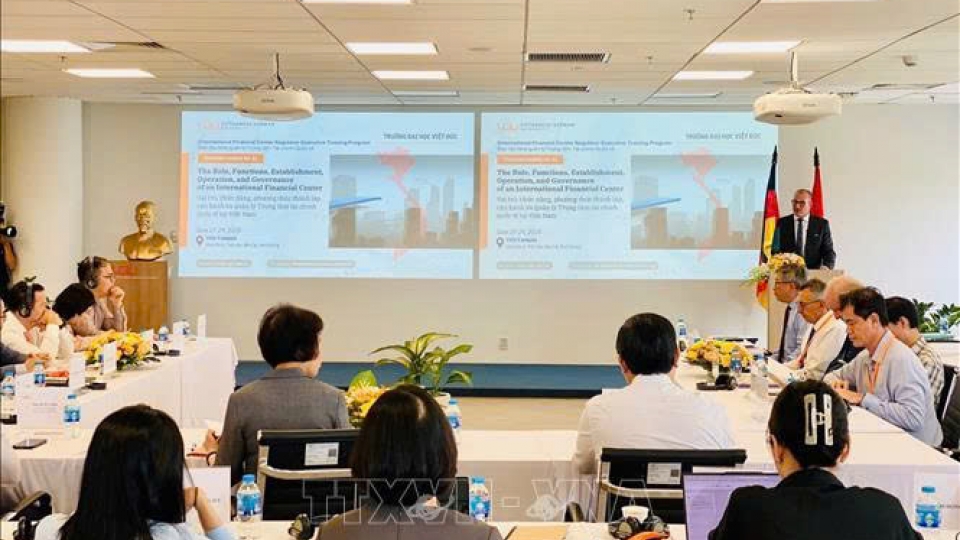
German experts train Vietnam international financial centre officials
VOV.VN - Vietnamese-German University (VGU) on June 27 opened its first training course for managers of Vietnam’s international financial centre, drawing the participation of leading experts from Germany.

