Experts call for broader ecosystem to develop Vietnam's carbon market

VOV.VN - Vietnam needs to develop a comprehensive ecosystem of carbon products, services and regulations to ensure its newly launched domestic carbon market operates effectively, according to experts.

Vietnam recently launched its domestic carbon exchange, marking an important milestone in the development of the country's carbon market. However, experts and businesses said a broader ecosystem of products, services and regulations is needed to ensure the market operates efficiently, improves liquidity and gradually integrates with international carbon markets.
Under a decision issued by the Prime Minister, greenhouse gas emission allowances for the 2025–2026 pilot phase have been allocated to 110 facilities in three carbon-intensive industries – thermal power, cement and steel.
The total volume of allowances registered for trading amounts to around 511 million tonnes of carbon dioxide equivalent (CO₂e), providing the foundation for Vietnam's emissions trading market.
On the first trading day, a number of companies entered the market to familiarise themselves with the new trading mechanism.
Among them was INSEE Vietnam, member of Siam City Cement Public Company Limited (SCCC), which has accumulated surplus emission allowances through years of investment in emissions-reduction technologies.
According to Dao Nguyen Khanh, head of Sustainability Development and Communications at INSEE Vietnam, the Government has allocated INSEE approximately 3.15 million tonnes of CO₂e in emission allowances for the 2025–2026 period.
“Thanks to years of investment in low-carbon technologies, we currently have a surplus of about 512,000 tonnes of CO₂e, which can be offered to the market. On the first trading day, we placed two sell orders and one buy order with relatively small volumes to familiarise ourselves with the exchange's operating mechanism,” he told VOV.
Trading prices on the opening day ranged from VND130,000 to VND136,000 per tonne of CO₂e, or roughly US$5 per tonne. That level is significantly lower than prices in more mature carbon markets such as the European Union Emissions Trading System (EU ETS), where carbon allowances typically trade between €60 and €80 per tonne, and have at times exceeded €100.
However, market observers said such pricing is typical for a newly established pilot market. More importantly, they noted, Vietnam has taken the first step toward establishing a domestic carbon pricing mechanism that can provide market signals for future emissions reductions.
A representative of Song Lam Cement JSC said participation in the carbon market not only creates additional incentives to cut emissions but also helps businesses prepare for integration with international carbon markets.
“This is a new direction and also an opportunity for businesses to improve energy efficiency and reduce emissions in production,” said Hoang Minh Tuan, director of Song Lam Cement JSC.
“Participating in the domestic carbon exchange will help us become familiar with emissions trading mechanisms and lay the groundwork for accessing international carbon markets in the future. For the cement industry, where exports still account for a significant share of output, this is also an important step toward adapting to the global green transition.”
Despite the positive start, trading during the pilot phase, which runs until 2028, remains limited to greenhouse gas emission allowances allocated to the three major emitting industries.
Experts noted that trading in carbon credits, along with a wider range of supporting products and services, is expected to expand only after Vietnam further develops its measurement, reporting and verification (MRV) system and completes the legal framework governing the carbon market.
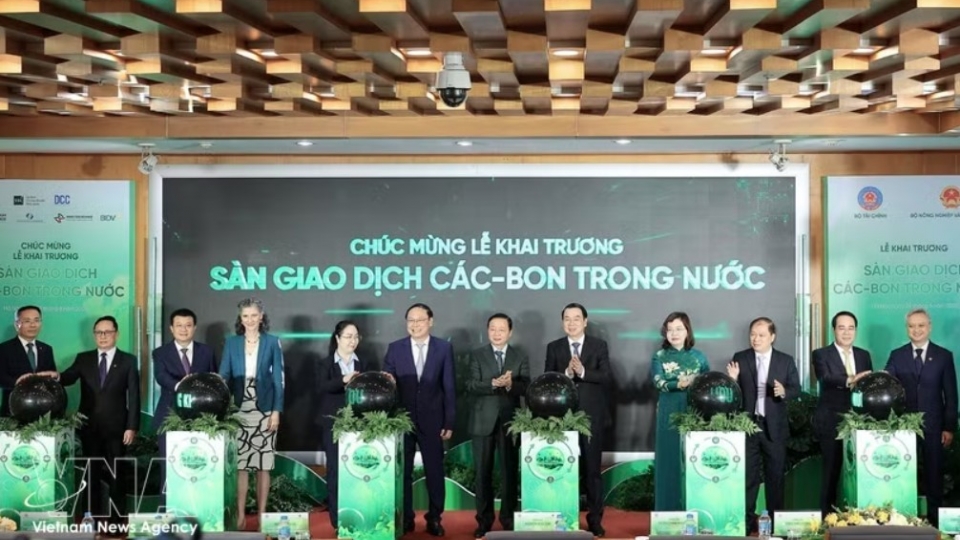
Vietnam’s domestic carbon exchange launched
Vietnam officially launched its domestic carbon exchange at the Hanoi Stock Exchange (HNX) on June 29, marking a major step in linking environmental responsibility with economic incentives and advancing the country’s green growth agenda.