A 200-year-old craft village heats up for Tet in Mekong Delta

VOV.VN - In the days leading up to the Lunar New Year (Tet), the centuries-old rice paper village of Thuan Hung in the Mekong Delta city of Can Tho hums with activity, blending tradition and modern machinery to keep pace with rising orders.
Rice paper tells the story of a village
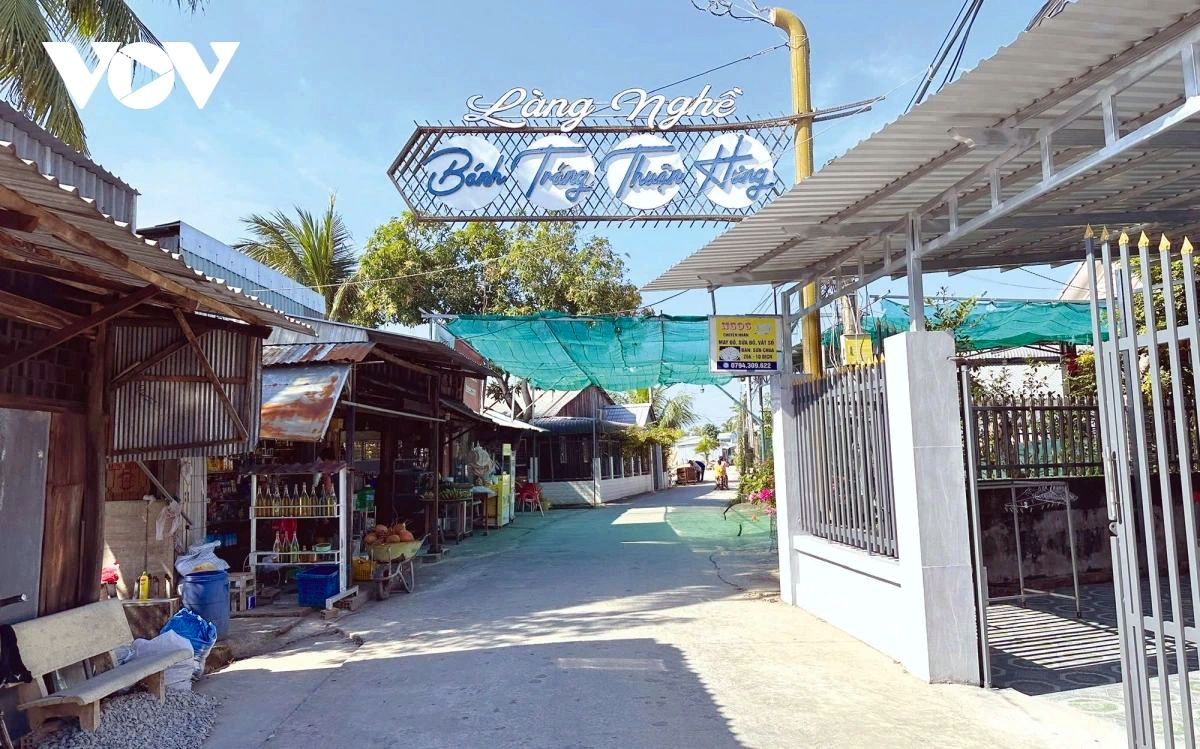
Located in Thuan Hung ward of Can Tho, about an hour from the city centre, Thuan Hung rice paper village welcomes visitors with the fragrant aroma of rice flour and coconut rice paper that fills the narrow lanes leading into the community.
In the days leading up to Tet, the village becomes busier than ever. From dawn until late afternoon, kilns glow red as households race against time to fulfill orders. By 4 a.m., many workshops in Tan Phu area have already begun a new workday. Freshly ground batter, smooth and silky, is prepared for the first batches.
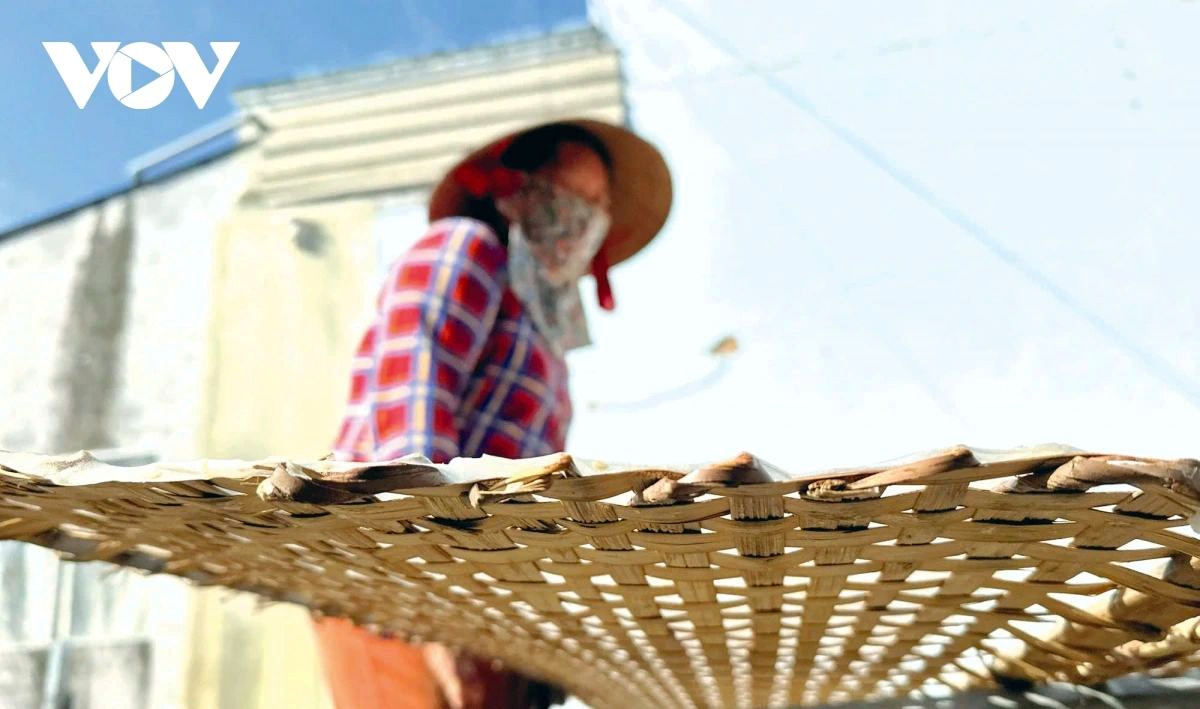
In households without automated steaming machines, artisans still stand beside steaming pots, deftly ladling batter onto cloth-covered moulds. Within seconds, a delicate, translucent sheet forms. It is swiftly lifted, placed on bamboo racks and set out under the sun to dry.
Every step requires skill and experience. The batter must achieve the right balance of elasticity and fluidity; the heat must remain steady; hands must move quickly yet firmly. A slight misstep can result in torn sheets or uneven thickness.
Thuan Hung rice paper carries a distinctive flavour. The village produces savoury, plain, spring-roll and coconut varieties, each in multiple sizes.
Outside, hundreds of bamboo racks are neatly arranged under the gentle Mekong Delta sun that is warm enough to dry the sheets evenly while preserving their softness and fragrance.
The “soul” of rice paper
Carefully stirring a pot of palm sugar, Van Thi Tho, owner of the family-run Ut Tho rice paper workshop, explains that batter preparation is the “soul” of the craft. Steam rises, blending the subtle sweetness of palm sugar with the rich aroma of grated coconut.
Rice must be carefully selected - aged just enough, neither too new nor too dry. It is finely ground and mixed with coconut milk and palm sugar according to a family recipe passed down through generations.
“If the batter isn’t good, the rice paper cannot be good,” she says. “It must be elastic and smooth so the sheets come out beautifully without tearing.”
Her family has been in the trade for three generations. For her, the craft is not only a livelihood but a legacy — from her husband’s grandmother to her mother-in-law, and now to her.
During the Tet peak season, demand surges. Yet her household focuses on two signature products: coconut rice paper and sweet rice paper – the traditional varieties that have built the village’s reputation.
At peak capacity, output increases three to four times compared to normal days. The family hires three to four additional workers. Each day, they produce around 6,000 sweet rice papers and 2,000 coconut rice papers, earning a modest daily profit after costs.
Keeping the craft’s flame alive

While respecting tradition, Tho acknowledges that machinery has reshaped the village. Automated steamers boost productivity and ensure uniform, thinner sheets. Still, machines are merely tools. She maintains traditional batter mixing methods and continues sun-drying the sheets on bamboo racks to preserve their natural aroma.
What concerns many artisans most is generational continuity. Younger residents increasingly seek work elsewhere, viewing the craft as labour-intensive and less stable than factory jobs.
Bien Van Con, who has worked in the trade for over 20 years, says artisans labour from early morning until late afternoon throughout the Tet rush, often without days off.
Tran Thanh Tam, whose family has been in the craft for three generations, invested in a rice paper machine nearly three years ago at a cost exceeding VND100 million. His workshop now employs six workers year-round and ramps up production significantly during Tet.
Today, only about 58 households maintain regular production in the village, rising to nearly 200 during the pre-Tet peak - still far fewer than decades ago.
In recent years, positive signs have emerged. Several products have received three-star One Commune Once Product (OCOP) cecertification, and in 2023, Thuan Hung rice paper village was officially recognised as a National Intangible Cultural Heritage.
According to Le Duc Toan, Secretary of the Party Committee of Thuan Hung ward, local authorities are facilitating preferential loans, supporting equipment upgrade, assisting in product promotion and brand development, and coordinating vocational training to enhance product quality and value.
After more than two centuries, the kilns of Thuan Hung continue to glow. Each thin, fragrant sheet of rice paper carries with it memories of the countryside, the diligence of its artisans and the pride of a heritage craft village.
Grilled fish village in Nghe An at peak output ahead of Lunar New Year
VOV.VN - At grilling sites across Cua Lo Ward, central Nghe An province, tonnes of fish are grilled around the clock over charcoal fires and shipped out continuously to supply the market ahead of the Lunar New Year of the Horse 2026.